Data without the doubt. Unmatched sensitivity. Unrivaled specificity.
Why are sensitivity and specificity important?
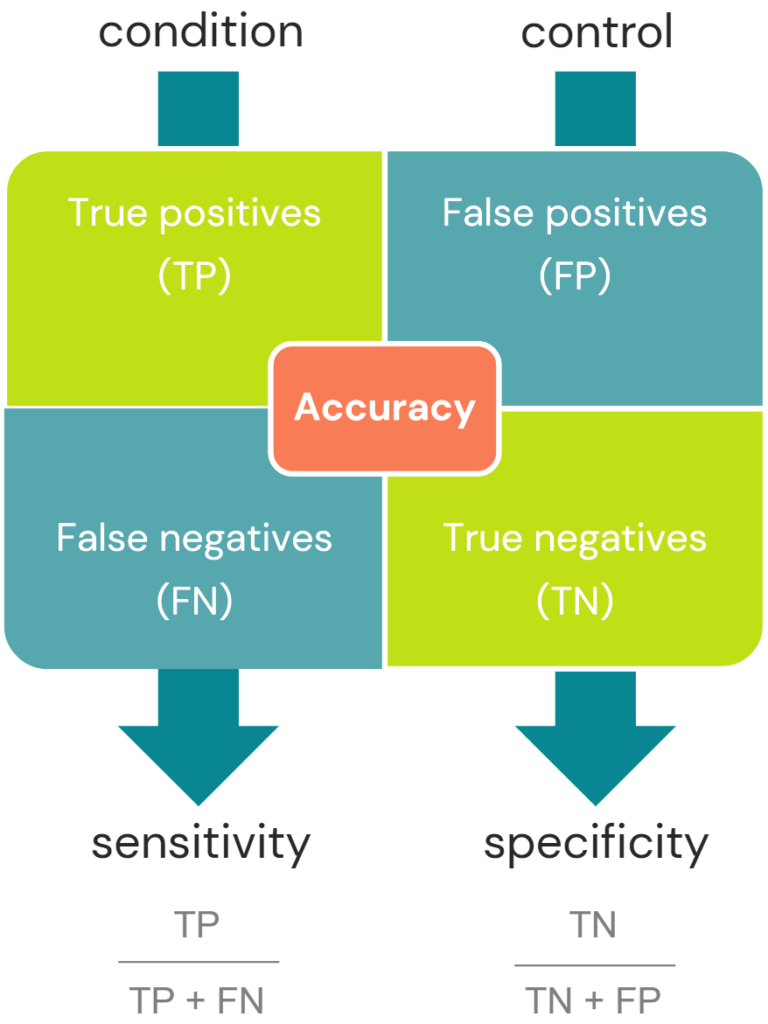
Sensitivity is all about detection. It measures how well a method can spot true signals—whether that’s a rare genetic variant, a subtle methylation change, or a trace of tumour DNA hidden among normal cfDNA. High sensitivity means fewer missed calls and greater confidence in early detection.
Specificity ensures the test correctly identifies what’s not there, reducing false positives. In the lab, analytical sensitivity and specificity are measured using well-characterised controls to set a technical benchmark. But real-world performance matters most—especially specificity, which prevents healthy individuals from being wrongly flagged, facing unnecessary stress or follow-up.
Together, sensitivity and specificity determine how well a technology separates signal from noise – finding the “needle in the haystack” without mistaking harmless straw for something dangerous. The best solutions achieve both.
High sensitivity
Detects true signals
Minimises false negatives
Critical for early diagnosis & treatment
High specificity
Confirms the absence of a signal
Minimises false positives
Prevents unnecessary tests & anxiety
Data without the doubt. Unmatched sensitivity. Unrivaled specificity.
Performance metrics show biomodal's duet technology is best in class
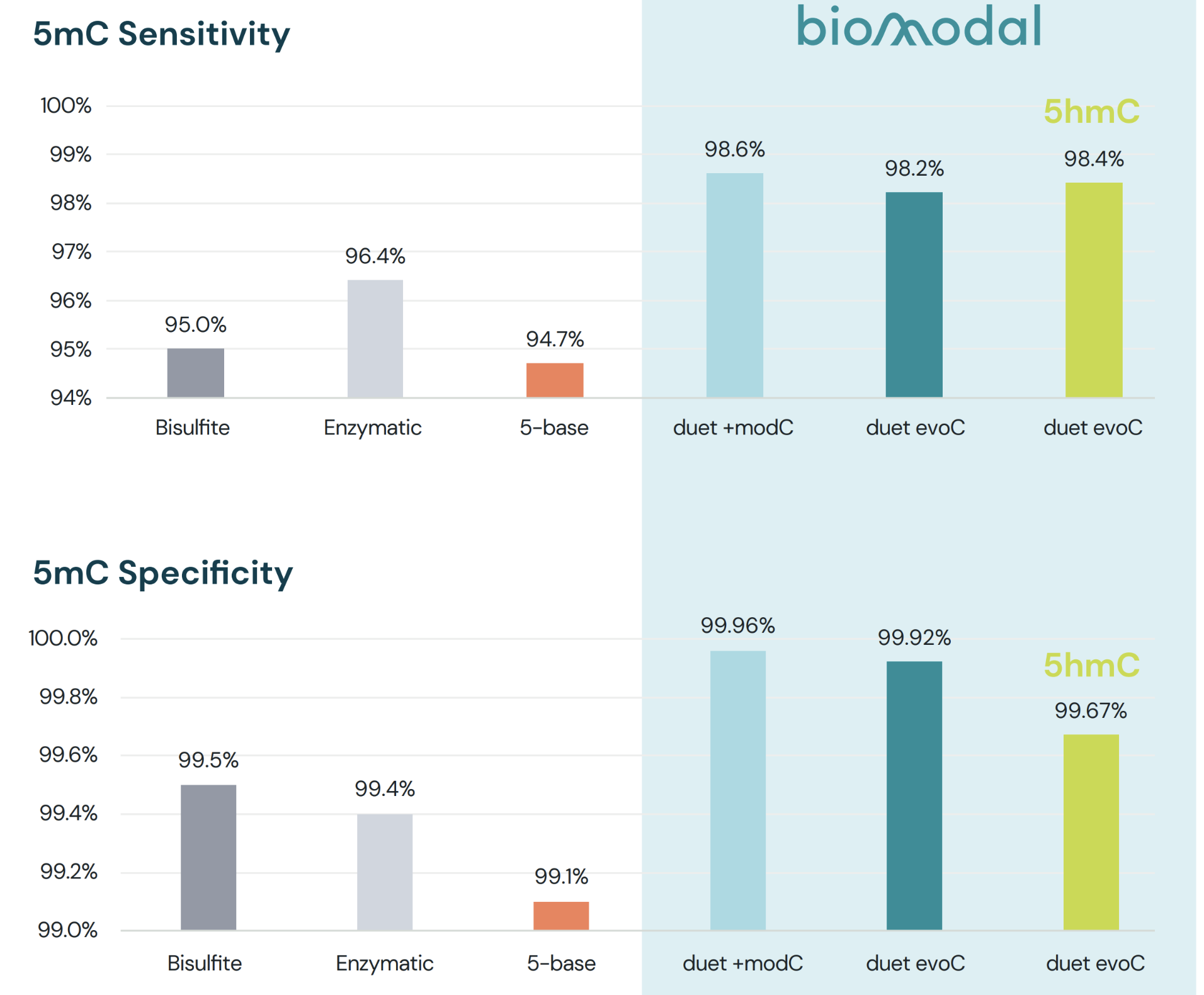
A comparison to published data on a 5-base product shows it is less sensitive and less specific than bisulfite
biomodal’s duet multiomics solution +modC (5-base data) and duet multiomics solution evoC (6-base data) outperform all technologies for 5mC sensitivity and specificity
biomodal’s duet multiomics solution evoC has the additional advantage of accurately detecting 5hmC as well, an important modification with biological significance
The data exposes what's missing
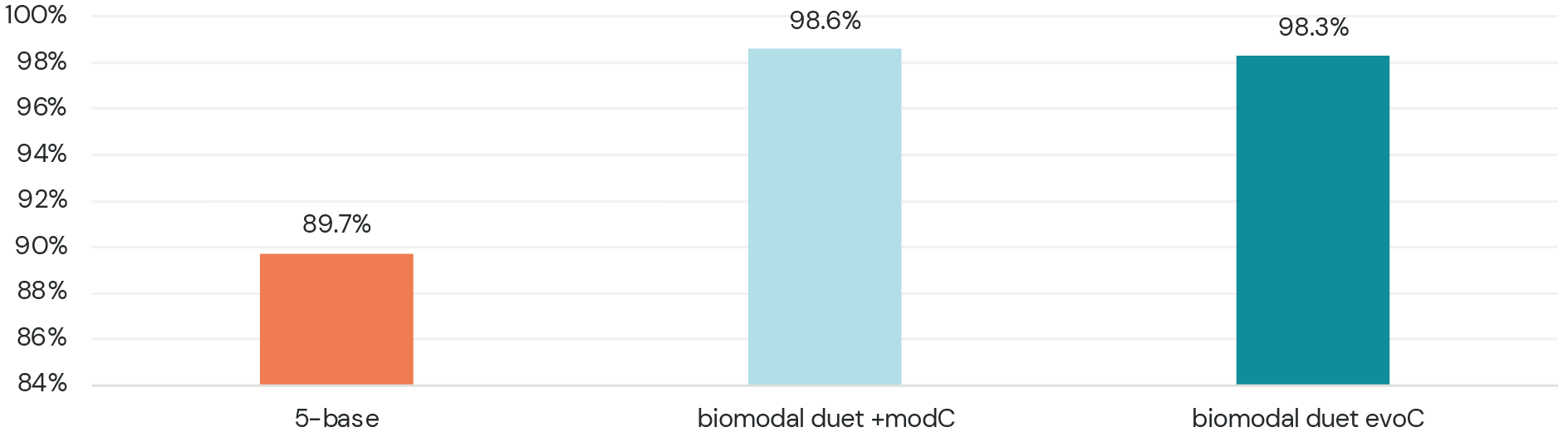
Modified cytosine sensitivity
Competitive 5-base data gaps
Modified cytosine is reported when 5mC and 5hmC signals are summed
biomodal’s duet products separately label and measure 5mC and 5hmC in each run, meaning the sensitivity of the solution to modified cytosine is high
In comparison, the 5-base product only detects and measures 5mC
Published data for the 5-base method shows ~5% error rate for calling 5mC
On average ~5% of modified cytosines in human tissues are 5hmC which are not detected by the 5-base method
Poor 5mC sensitivity and no 5hmC detection means ~10% of CpGs are missing or miscalled
Source: 5-base data from Fiona Kaper’s blog.
duet evoC enables the option to start with 5-base data, and unlock 6-base insights later
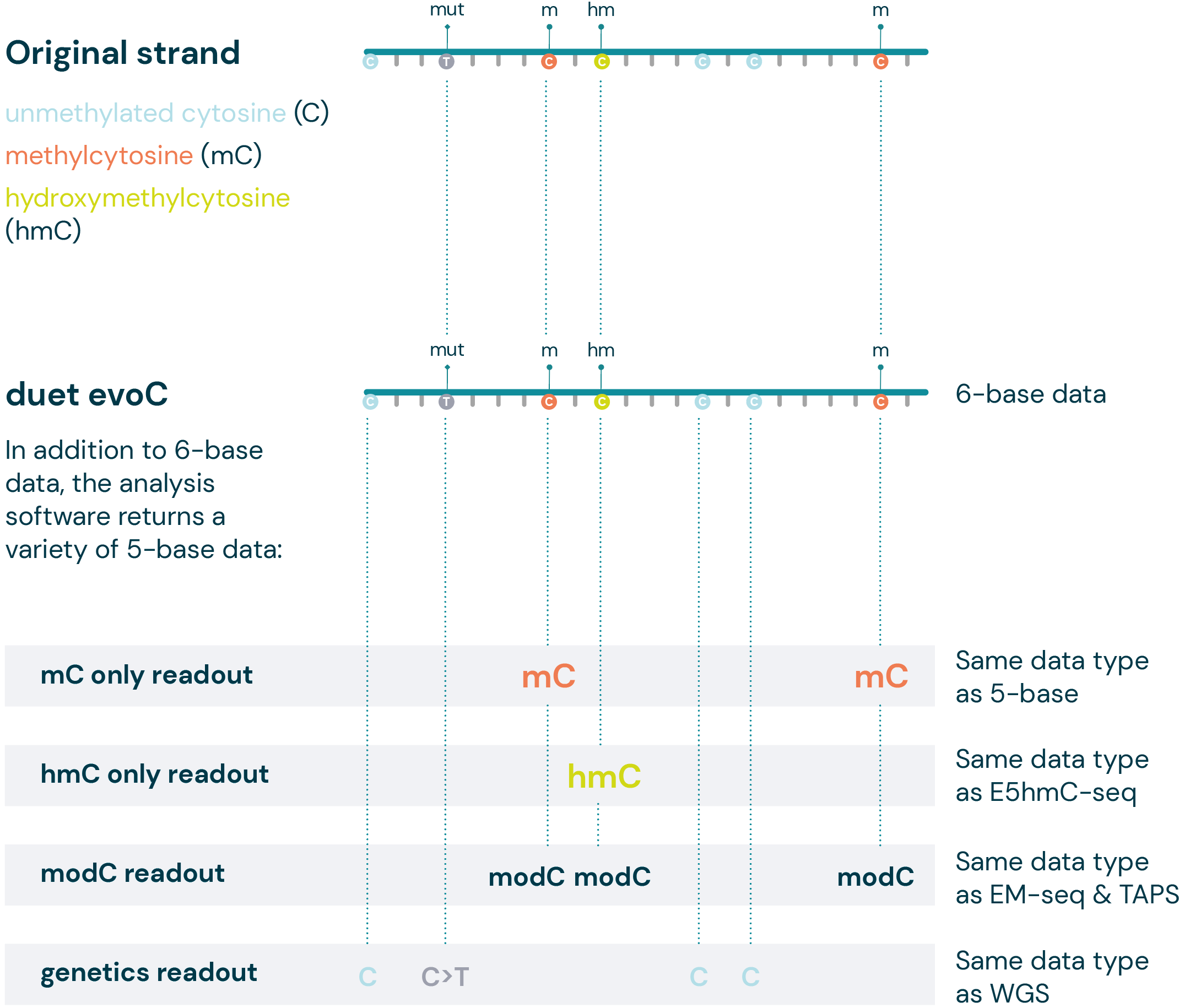
biomodal’s duet analysis software returns a 6-base readout, as well as individual reports of hmC, mC, modified C (modC) and the canonical bases, with higher accuracy than on-market alternatives.
From one sample and one workflow, duet evoC provides the same data as 5‑base, E5hmC‑seq, EM‑seq, TAPS, and WGS