- Aurelie Modat
- Luke Sarre
- Robert Blanshard
- Chris Renders
- Lisabet Andreasen
- Fabio Puddu
- Tom Charlesworth
- Robert Osborne
- Thao Hunyh
- Robert Crawford
biomodal Ltd, The Trinity Building, Chesterford Research Park, Cambridge, UK.
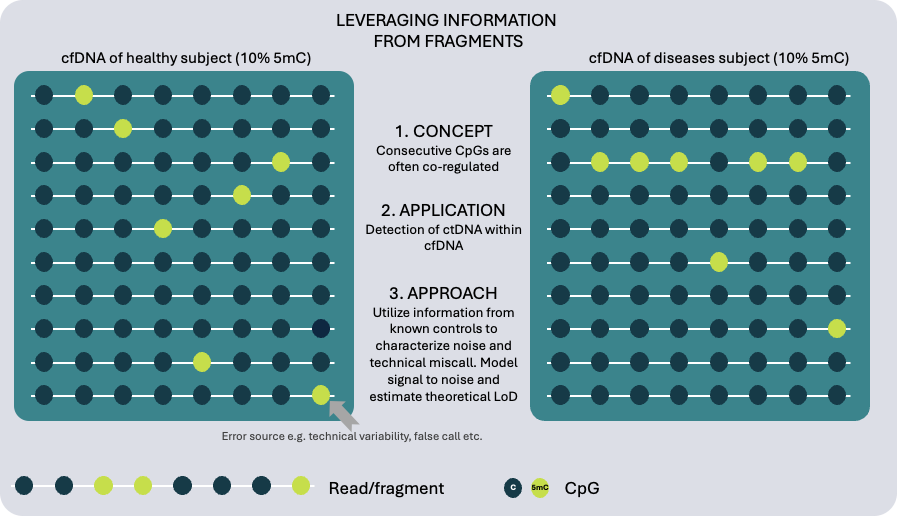
The figure shows a hypothetical example of sequencing reads in a region from cfDNA from healthy and diseased subjects with 1% methylation across all CpGs. However in the healthy sample methylation is randomly distributed whereas in disease samples two fragments are consistently methylated across multiple CpGs, standing out from an unmethylated background and indicating those reads derive from circulating tumour DNA (ctDNA).
When analysed at the per CpG level the samples are indistinguishable with 10% methylation. However, fragment level analysis examines CpG statuses along individual reads, enabling rare, highly methylated fragments to be distinguished from an umethylated background, or vice versa. By leveraging fragment level information, correlated CpG patterns can be combined into a single molecular observation, increasing the effective signal to noise ratio and enabling sensitive detection of low frequency methylation events while maintaining high specificity. We have previously shown that for hypermethylated regions, duet evoC achieves an LoD of 2.7 ppm (5mC) and duet +modC achieves an LoD of 3.9 ppm.
Building on this, here we investigated the impact of a duet single stranded ligation workflow on methylation LoD (further details on duet single stranded ligation workflow are provided in poster #121) across duet +modC (which provides 5-base data) and duet evoC (which provides 6-base data, distinguishing between 5mC and 5mC).
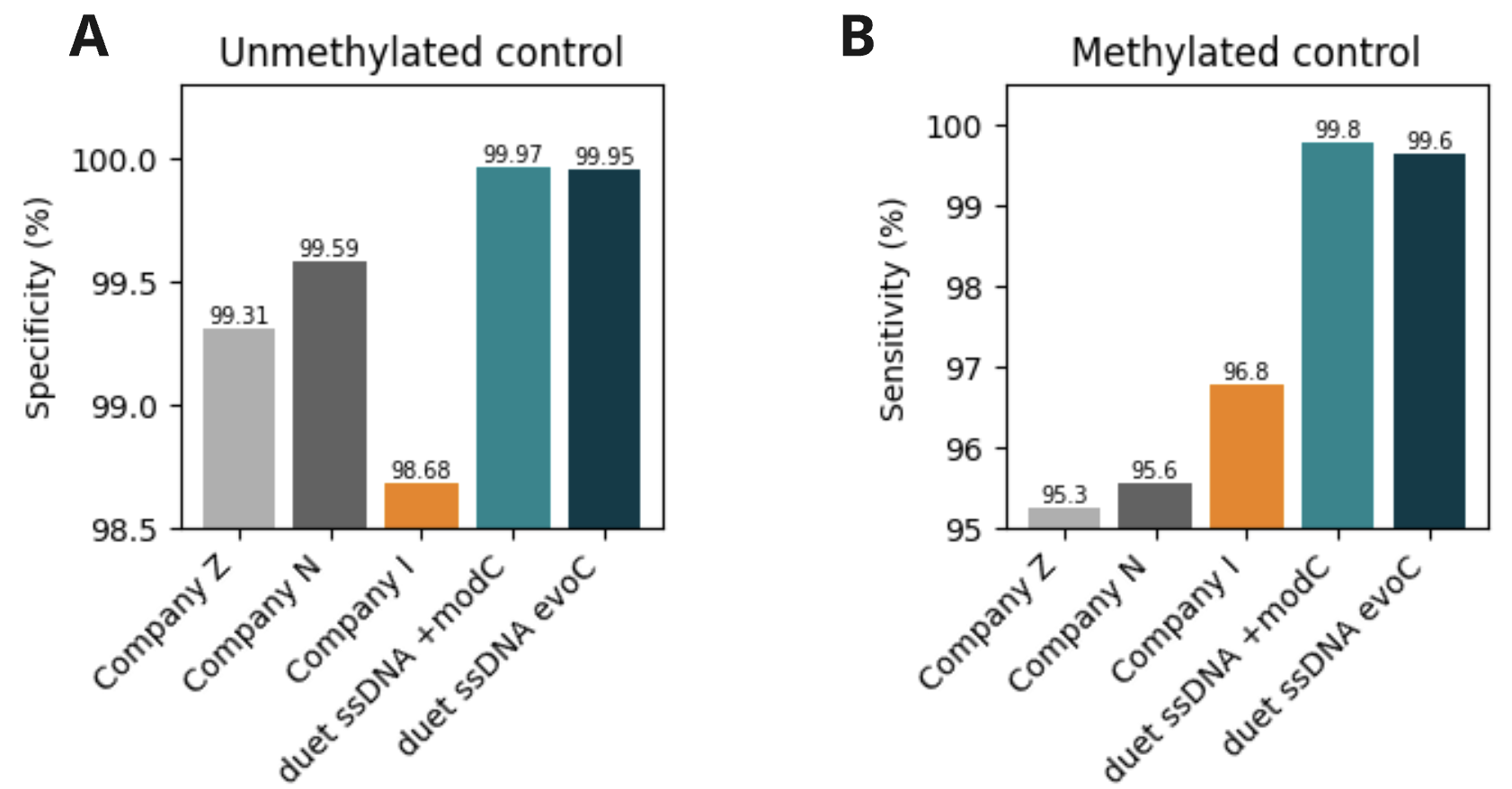
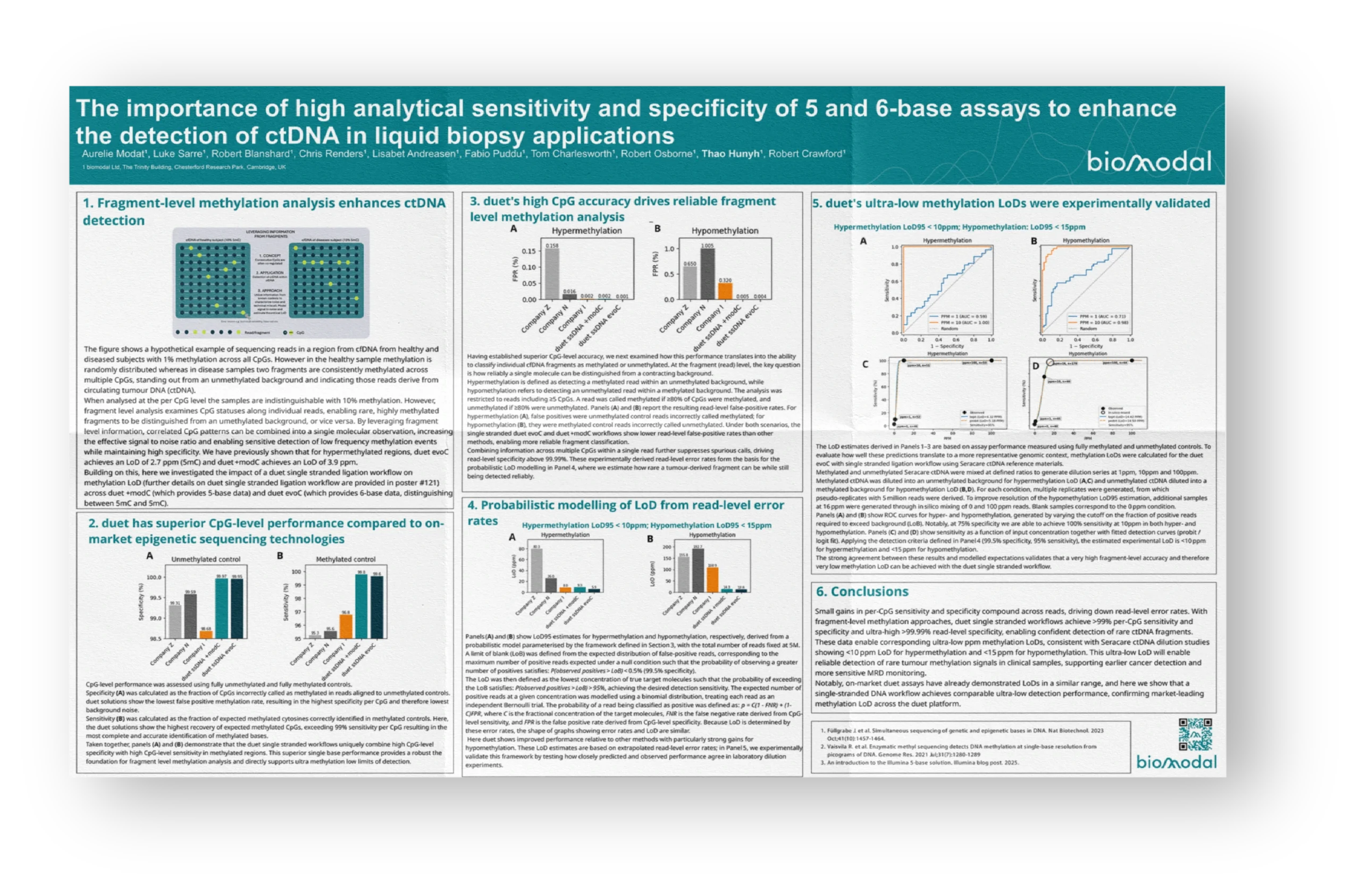
CpG-level performance was assessed using fully unmethylated and fully methylated controls.
Specificity (A) was calculated as the fraction of CpGs incorrectly called as methylated in reads aligned to unmethylated controls. duet solutions show the lowest false positive methylation rate, resulting in the highest specificity per CpG and therefore lowest background noise.
Sensitivity (B) was calculated as the fraction of expected methylated cytosines correctly identified in methylated controls. Here, the duet solutions show the highest recovery of expected methylated CpGs, exceeding 99% sensitivity per CpG resulting in the most complete and accurate identification of methylated bases.
Taken together, panels (A) and (B) demonstrate that the duet single stranded workflows uniquely combine high CpG-level specificity with high CpG-level sensitivity in methylated regions. This superior single base performance provides a robust the foundation for fragment level methylation analysis and directly supports ultra methylation low limits of detection.
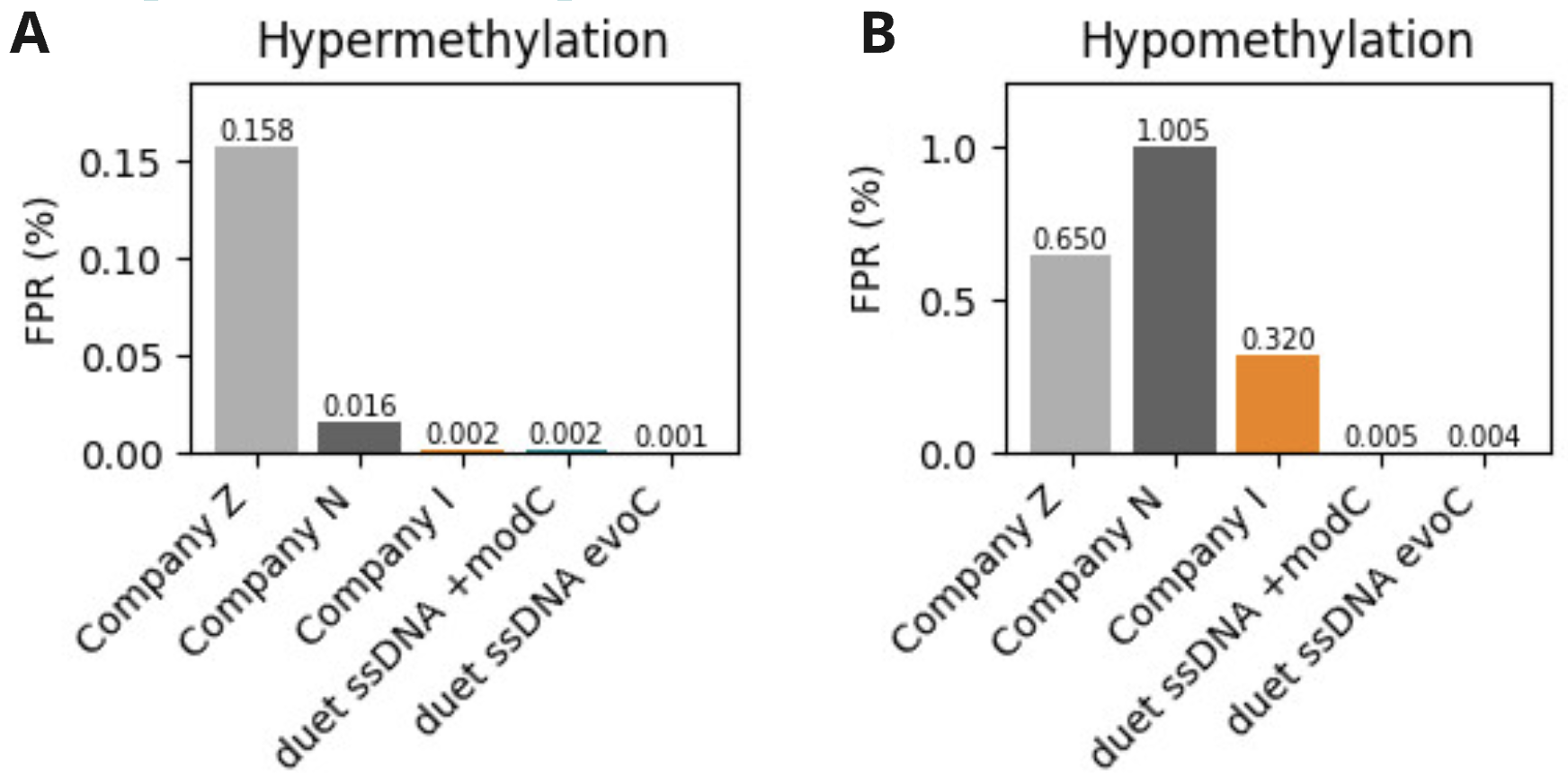
Having established superior CpG‑level accuracy, we next examined how this performance translates into the ability to classify individual cfDNA fragments as methylated or unmethylated. At the fragment (read) level, the key question is how reliably a single molecule can be distinguished from a contracting background.
Hypermethylation is defined as detecting a methylated read within an unmethylated background, while hypomethylation refers to detecting an unmethylated read within a methylated background. The analysis was restricted to reads including ≥5 CpGs. A read was called methylated if ≥80% of CpGs were methylated, and unmethylated if ≥80% were unmethylated. Panels (A) and (B) report the resulting read‑level false‑positive rates. For hypermethylation (A), false positives were unmethylated control reads incorrectly called methylated; for hypomethylation (B), they were methylated control reads incorrectly called unmethylated. Under both scenarios, the single stranded duet evoC and duet +modC workflows show lower read‑level false‑positive rates than other methods, enabling more reliable fragment classification.
Combining information across multiple CpGs within a single read further suppresses spurious calls, driving read‑level specificity above 99.99%. These experimentally derived read‑level error rates form the basis for the probabilistic LoD modelling in Panel 4, where we estimate how rare a tumour‑derived fragment can be while still being detected reliably.
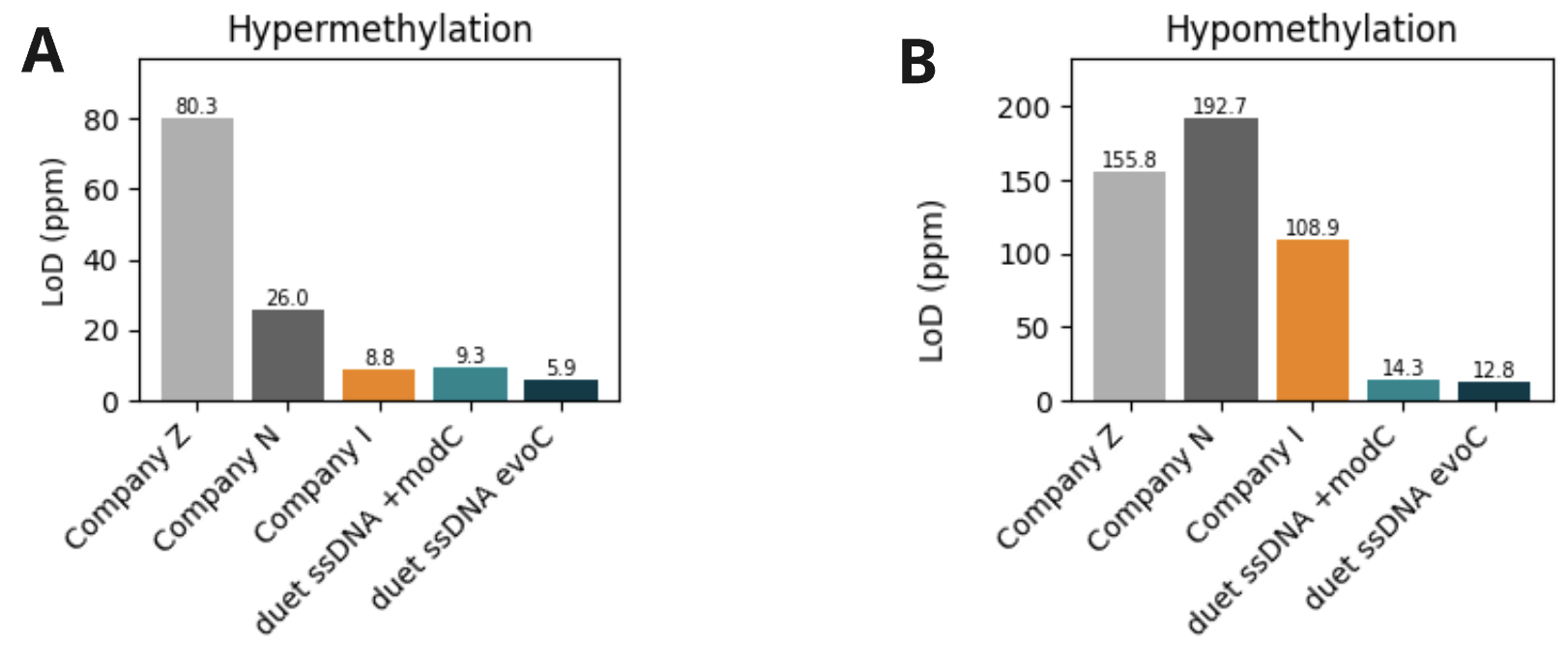
Panels (A) and (B) show LoD95 estimates for hypermethylation and hypomethylation, respectively, derived from a probabilistic model parameterised by the framework defined in Section 3, with the total number of reads fixed at 5M.
A limit of blank (LoB) was defined from the expected distribution of false‑positive reads, corresponding to the maximum number of positive reads expected under a null condition such that the probability of observing a greater number of positives satisfies: P(observed positives > LoB) < 0.5% (99.5% specificity).
The LoD was then defined as the lowest concentration of true target molecules such that the probability of exceeding the LoB satisfies: P(observed positives > LoB) > 95%, achieving the desired detection sensitivity. The expected number of positive reads at a given concentration was modelled using a binomial distribution, treating each read as an independent Bernoulli trial. The probability of a read being classified as positive was defined as: p = C(1 – FNR) + (1-C)FPR, where C is the fractional concentration of the target molecules, FNR is the false negative rate derived from CpG-level sensitivity, and FPR is the false positive rate derived from CpG-level specificity. Because LoD is determined by these error rates, the shape of graphs showing error rates and LoD are similar.
Here duet shows improved performance relative to other methods with particularly strong gains for hypomethylation. These LoD estimates are based on extrapolated read‑level error rates; in Panel 5, we experimentally validate this framework by testing how closely predicted and observed performance agree in laboratory dilution experiments.
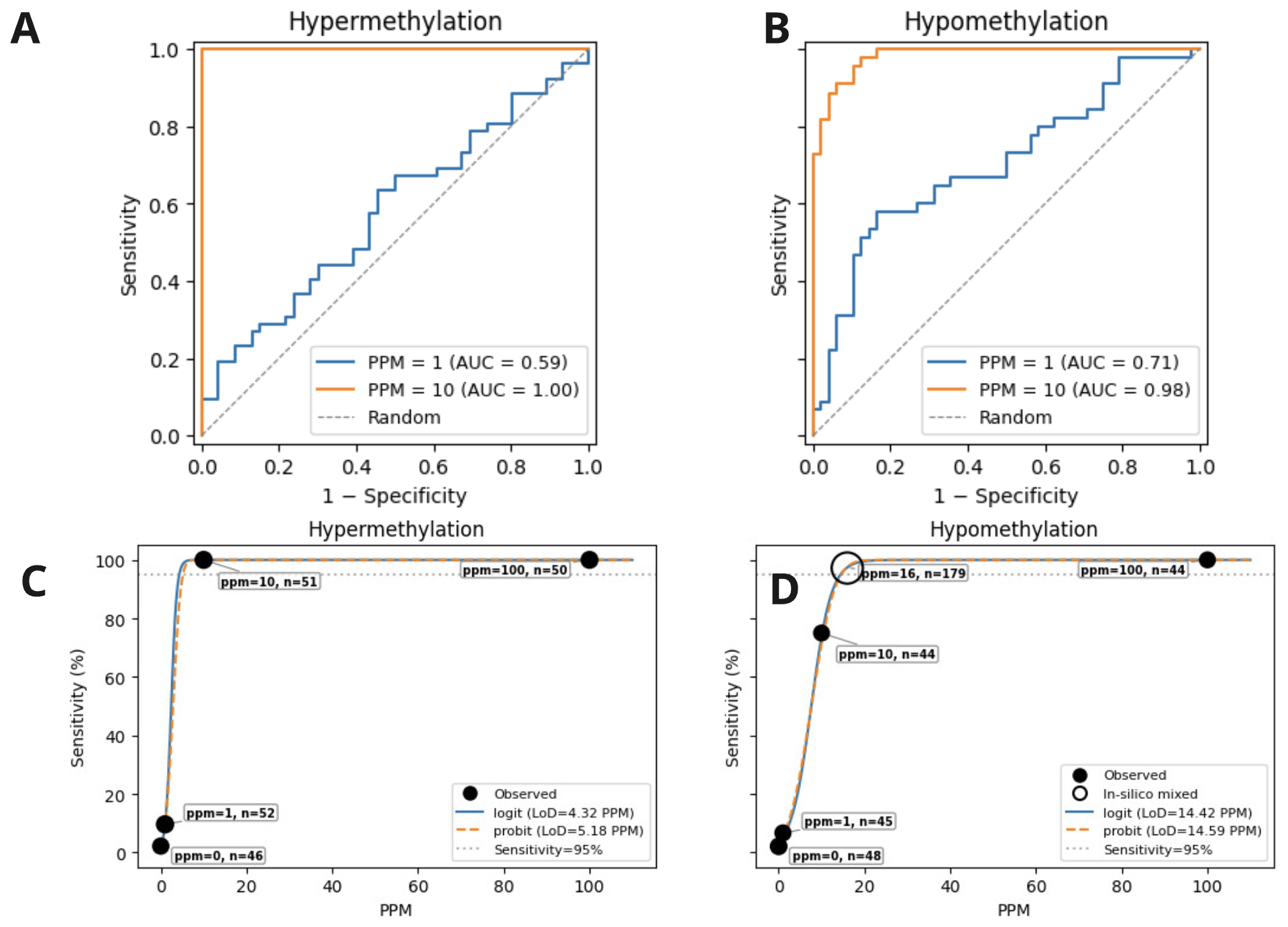
The LoD estimates derived in Panels 1–3 are based on assay performance measured using fully methylated and unmethylated controls. To evaluate how well these predictions translate to a more representative genomic context, methylation LoDs were calculated for the duet evoC with single stranded ligation workflow using Seracare ctDNA reference materials.
Methylated and unmethylated Seracare ctDNA were mixed at defined ratios to generate dilution series at 1ppm, 10ppm and 100ppm. Methylated ctDNA was diluted into an unmethylated background for hypermethylation LoD (A,C) and unmethylated ctDNA diluted into a methylated background for hypomethylation LoD (B,D). For each condition, multiple replicates were generated, from which pseudo‑replicates with 5 million reads were derived. To improve resolution of the hypomethylation LoD95 estimation, additional samples at 16 ppm were generated through in silico mixing of 0 and 100 ppm reads. Blank samples correspond to the 0 ppm condition.
Panels (A) and (B) show ROC curves for hyper‑ and hypomethylation, generated by varying the cutoff on the fraction of positive reads required to exceed background (LoB). Notably, at 75% specificity we are able to achieve 100% sensitivity at 10ppm in both hyper- and hypomethylation. Panels (C) and (D) show sensitivity as a function of input concentration together with fitted detection curves (probit / logit fit). Applying the detection criteria defined in Panel 4 (99.5% specificity, 95% sensitivity), the estimated experimental LoD is <10 ppm for hypermethylation and <15 ppm for hypomethylation.
The strong agreement between these results and modelled expectations validates that a very high fragment-level accuracy and therefore very low methylation LoD can be achieved with the duet single stranded workflow.
Small gains in per‑CpG sensitivity and specificity compound across reads, driving down read‑level error rates. With fragment-level methylation approaches, duet single stranded workflows achieve >99% per-CpG sensitivity and specificity and ultra-high >99.99% read‑level specificity, enabling confident detection of rare ctDNA fragments.
These data enable corresponding ultra-low ppm methylation LoDs, consistent with Seracare ctDNA dilution studies showing <10 ppm LoD for hypermethylation and <15 ppm for hypomethylation. This ultra‑low LoD will enable reliable detection of rare tumour methylation signals in clinical samples, supporting earlier cancer detection and more sensitive MRD monitoring.
Notably, on‑market duet assays have already demonstrated LoDs in a similar range, and here we show that a single‑stranded DNA workflow achieves comparable ultra‑low detection performance, confirming market‑leading methylation LoD across the duet platform.
- Füllgrabe J. et al. Simultaneous sequencing of genetic and epigenetic bases in DNA. Nat Biotechnol. 2023 Oct;41(10):1457-1464.
- Vaisvila R. et al. Enzymatic methyl sequencing detects DNA methylation at single-base resolution from picograms of DNA. Genome Res. 2021 Jul;31(7):1280-1289
- An introduction to the Illumina 5-base solution. Illumina blog post. 2025.