American Society of Human Genetics Annual Meeting (ASHG) 2025

Reveal the power of the 6-base genome.
14 October 2025
to 18 October 2025
Boston Convention and Exhibition Center
, Boston
, United States of America

Visit biomodal at booth 

#832

About the event

The ASHG annual meeting provides a forum for presenting and discussing cutting-edge science in all areas of human genetics and genomics. ASHG members and leading scientists from around the world are selected to present their research findings at featured symposiums, interactive workshops, plenary sessions, platform talks, lightning talks, and poster sessions.


Presenting at the event

Precision and power: the 6-base genome elevates your multiomic analysis beyond DNA

Robert Blanshard

Product Manager

biomodal

Wednesday, October 15, 2025 | 12:00 PM - 1:00 PM |Room 151B

In this talk, we will explore the fascinating world of the 6-base genome, including how combining measurement of 5-methylcytosine (5mC) and 5-hydroxymethylcytosine (5hmC) can predict gene expression from DNA. We will reveal how 5mC and 5hmC levels vary across tissues, allowing us to deconvolute heterogeneous DNA samples from complex tissues or cell-free DNA (cfDNA). We will also highlight how 6-base fragment level analysis can provide insights into disease states like cancer and neurological disorders. Furthermore, we will uncover new insights into how the 6-base genome regulates the genome and gene expression.

Unraveling Epigenetic and Genetic Deregulation in Mutation-Specific Chronic Myelomonocytic Leukemia

Terra Lasho, PhD

Assistant Professor of Medicine

Mayo Clinic

Wednesday, October 15, 2025 | 12:00 PM - 1:00 PM |Room 151B

Advanced sequencing technologies are becoming more accessible, with higher resolution, allowing us to identify genetic alterations oftentimes before disease is clinically detectable. Because of this, there is a push for early detection of cancer and interventional testing strategies. Some of the most frequently mutated genes involved in disease initiation are epigenetic regulators, leading to open chromatin and dysregulation of cellular signaling. Because many of these epigenetic changes are potentially reversible, they are attractive therapeutic targets. One highly relevant gene that is mutated in precancer as well as cancer is ASXL1. In the myeloid neoplasm chronic myelomonocytic leukemia (CMML), 40% of cases are mutated in ASXL1. Our group has previously demonstrated that ASXL1-mutant (mt) CMML is characterized by permissive chromatin states and overexpression of leukemia stemness genes (Binder et al. Nat Commun; 2022). We subsequently identified the aberrant expression of DLK1 (delta-like homolog 1), a maternally imprinted and paternally expressed gene, as a very relevant part of this signature. DLK1 expression has been associated with poor outcomes in solid tumors, and we have shown differential overexpression in ASXL1mt versus wild-type (wt) CMML. To inspect further, we utilized a novel, innovative 6 base sequencing methodology from biomodal (duet multiomics solution evoC) to investigate the methylation landscape, including 5mC and 5hmC, around this gene. Because this technology also includes whole genome sequencing, we were able to not only define the methylation signature of this gene in ASXL1mt patients but identify that de-regulation of imprinting by specific methylation patterns may be a key mechanism of this gene deregulation using allele-specific analysis of our data. This presents targetable regions for prospective interventional opportunities.

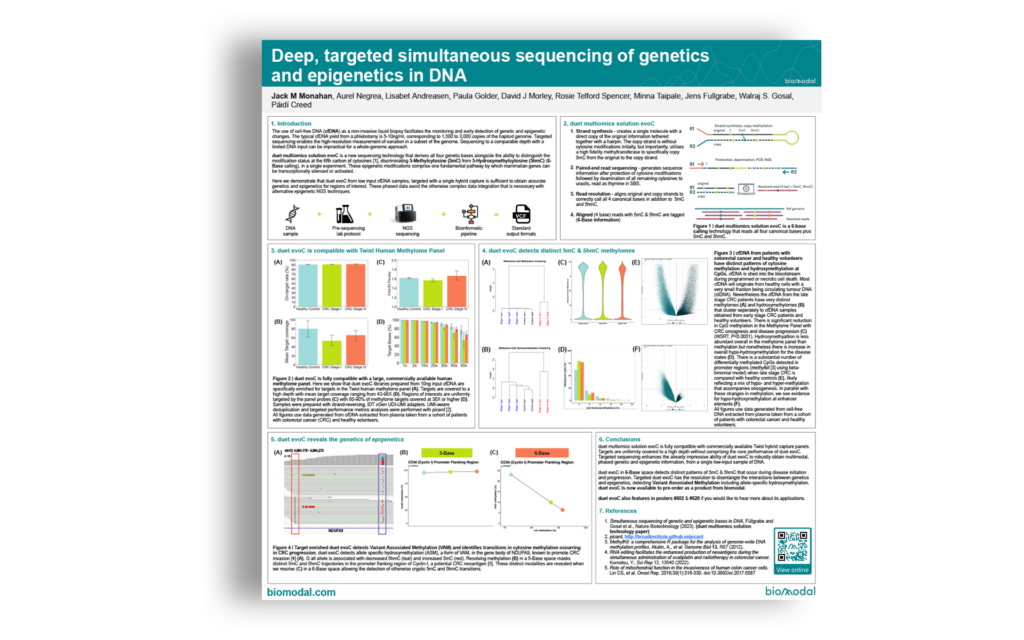
Poster Presentation: Mapping human tissues with 6-base sequencing

Robert Blanshard

Product Manager

biomodal

Wednesday, October 15, 2025 | 2:30-4:30 PM | Board 8043W

5-hydroxymethylcytosine, also known as the sixth DNA base of the genome, is known to have different distributions in different tissues, for example with a marked increase in neuronal tissues.  

Here, we apply 6-base sequencing, an assay capable of simultaneously detecting all four canonical DNA bases along with two key epigenetic modifications—5-methylcytosine (5mC) and 5-hydroxymethylcytosine (5hmC)—to comprehensively profile the epigenome of multiple tissues. 

Specifically, we generated a high-resolution 5-methylome and 5-hydroxymethylome profile from post-mortem human cerebellum and compared this to profiles from a panel of non-brain tissues, including liver, lung, and breast. Our analysis reveals that the cerebellum harbors a distinct epigenetic signature characterized by widespread 5hmC enrichment at neuronal gene bodies and enhancer regions, consistent with active transcriptional regulation. 

These findings demonstrate the power of 6-base sequencing to resolve tissue-specific epigenetic landscapes and underscore the cerebellum’s unique regulatory architecture. This approach provides a valuable framework for understanding tissue-specific gene regulation and its disruption in disease. 

Poster Presentation: Characterising cancer 6-base genomes using fresh frozen and formalin fixed tissue samples

Robert Blanshard

Product Manager

biomodal

Thursday, October 16, 2025 | 2:30-4:30 PM | Board 8054T

Formalin-fixed and paraffin-embedded (FFPE) specimens are a common source of long-term stored samples used for research or clinical settings in fields including immunohistochemistry, oncology, and genomics. Studies that incorporate both genomic and epigenomic information such as cytosine modification status (5mC & 5hmC) hold the promise of providing a better understanding of cancer and enabling its earlier detection1. The ability to derive combined genomic and epigenomic data from FFPE samples enables a meaningful increase in biological insight from this ubiquitous sample type. However, DNA damage induced by formalin fixation (e.g. deamination, fragmentation or nucleic acid crosslinking) can lead to decreased genomic and epigenomic data quality when using next generation sequencing (NGS) approaches.

Here we apply 6-base sequencing to DNA extracted from formalin-compromised DNA standards (fcDNA) as well as FFPE and Fresh Frozen (FF) samples from colorectal and lung cancers. 6-base sequencing offers simultaneous detection of both cytosine modifications (5mC, 5hmC) alongside canonical bases (A, C, T, G) at single-base resolution and with a low nanogram input requirement. Simultaneous detection avoids the information loss of other methods, while preserving the ability to discriminate important C-to-T transitions. We compare results from 6-base sequencing to other on-market epigenetic sequencing technologies.

Results and Discussion: As expected, increased levels of formalin damage to DNA corresponded to lower library yields and insert sizes, higher relative duplication and lower coverage rates. However, the genetic accuracy of 6-base sequencing was largely preserved, and minimal effect was observed on variant allele frequency (VAF) calling for all formalin compromised DNA standards even with severe damage (DIN ≤ 2.0). Comparing deep sequenced FFPE cancer samples to matched fresh frozen (FF) equivalents showed overall minimal impact on overall genetic and epigenetic information. Further, high reproducibility was observed both between replicates and between FFPE and FF of the same sample.

In conclusion we demonstrate compatibility of 6-base sequencing with formalin-compromised DNA, producing high accuracy genetic and epigenetic information from FFPE samples even at severe levels of DNA damage.

Poster Presentation: Inferring gene regulation from 6-base sequencing data

Mark Consugar

Associate Director of Scientific Affairs

biomodal

Thursday, October 16, 2025 | 2:30-4:30 PM | Board 8051T

DNA methylation, an epigenetic modification, plays a key role in the regulation of gene expression. Specifically, the addition of a methyl group to the 5th carbon of cytosine (5mC) is broadly associated with transcriptional repression, with patterns of methylation established during cell fate determination constraining the transcriptional programs in cells. Demethylation via oxidation of 5-methylcytosine to 5-hydroxymethylcytosine (5hmC) is performed by TET enzymes and is reflected by higher levels of 5hmC in the gene bodies of actively transcribed genes and at active or lineage-specific enhancers. 

Disentangling the roles of these two distinct modifications in gene regulation has been constrained by technological limitations, with most sequencing approaches conflating the two modifications into a single measure representing 5mC or 5hmC. Recent developments in sequencing technologies have enabled base-resolved simultaneous measurement of 5mC and 5hmC. Utilizing these developments, we have generated data-sets with whole-genome 5mC and 5hmC measurements paired with RNA-sequencing data, across a variety of different cell and tissue types. We show that distinct 5mC and 5hmC signatures for different tissue types, that patterns of 5mC and 5hmC can be used to discriminate the level of expression of different genes, and that machine learning models trained to predict RNA-seq data from 5mC and 5hmC can generalize to previously unseen samples. 

Find the venue

One sample. One workflow. One solution.

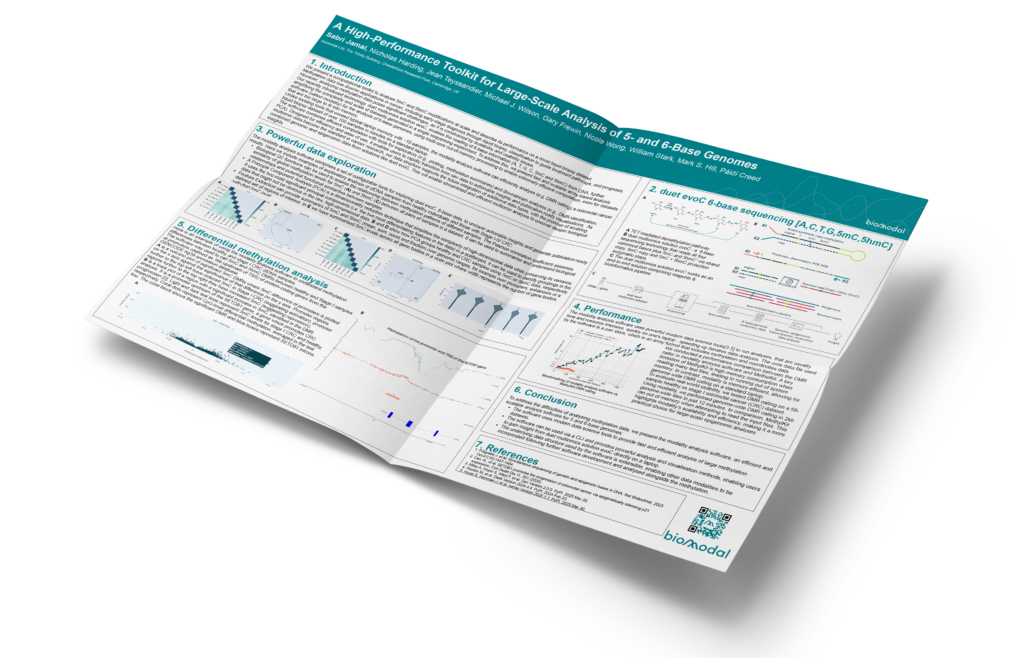
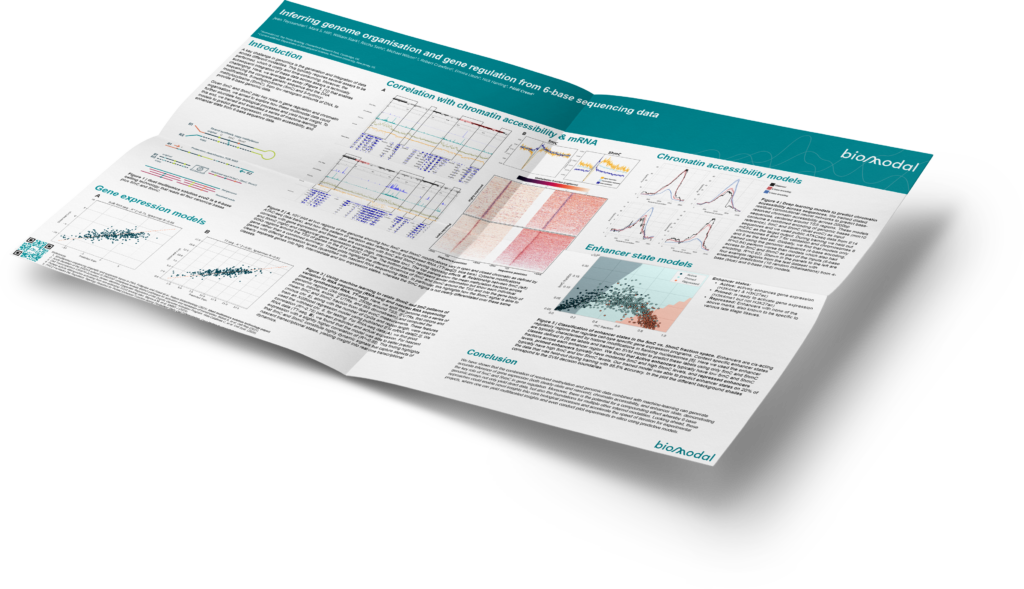
Here are the relevant biomodal resources for information. Find poster presentation information, case studies, interviews, and more.

Related resources

Attending from biomodal

Christine Hipsky

Christine Hipsky

US Territory Manager, Mid-Atlantic & Southeast
Craig Fishman

Craig Fishman

Regional Head of Sales, North America
Gianina LaChapelle

Gianina LaChapelle

Regional Marketing Manager
Jen Stone

Jennifer L. Stone, PhD

Vice President, Business Development and Customer Solutions
Kurt Yardley

Kurt Yardley

Director of Global Marketing
Mark Consugar

Mark Consugar

Associate Director of Scientific Affairs
Steven Ciaramaglia

Steven Ciaramaglia

US Territory Manager, Northeast

Register now

Meet our team at the event

ASHG 2025
181709756646

Stay up to date

Explore recent biomodal news and the events that we’ll be attending in the near future.

What are you looking for?