Canadian Conference on Circulating Biomarkers (CCCB) 2026

5 June 2026
to 6 June 2026
June 5th, 2026: Fairmont The Queen Elizabeth | June 6th, 2026: RI-MUHC Cruess Auditorium
, Montreal
, Canada

Visit biomodal at booth 

About the event

biomodal is proud to sponsor the 2026 Canadian Conference on Circulating Biomarkers (CCCB), the inaugural national meeting hosted by the RI‑MUHC Circulating Biomarkers of Health and Disease Research Network.

Established to advance research on circulating biomarkers across health and disease, the RI‑MUHC network brings together researchers, clinicians, trainees, and patient partners from the Research Institute of the McGill University Health Centre and beyond. Through interdisciplinary collaboration, scientific exchange, and translational initiatives, the network is helping to build a coordinated Canadian community focused on biomarker discovery, validation, and clinical implementation.

Join us at our table to meet Steven Ciaramaglia and discover how biomodal’s groundbreaking multiomic technology illuminates the 6‑base genome—empowering researchers to unravel epigenetic complexity with unprecedented clarity.

Venue & Dates

  • June 5, 2026 – Fairmont The Queen Elizabeth
    900 René‑Lévesque Blvd W, Montreal, Quebec, H3B 4A5
  • June 6, 2026 – RI‑MUHC Cruess Auditorium
    1001 Blvd Décarie, Block E, Montreal, Quebec, H4A 3J1

Presenting at the event

Poster Presentation: The importance of high analytical sensitivity and specificity of 5 and 6-base assays to enhance the detection of ctDNA in liquid biopsy applications

Thao Huynh

Scientific Affairs Partner

biomodal

Sensitive detection of cancer-derived DNA fragments (ctDNA) within cell-free DNA (cfDNA) in liquid biopsy is essential for identifying early-stage cancers, monitoring treatment response and minimal residual disease. A major challenge in these applications is detecting ctDNA, indicative of disease state, when this represents a small fraction of the total cfDNA. Advances in methylomic profiling, including 6-base sequencing with duet evoC which distinguishes 5-methylcytosine (5mC) and 5-hydroxymethylcytosine (5hmC), have enabled high-sensitivity ctDNA detection by analyzing methylation patterns across individual sequencing fragments (fragment level analysis) as opposed to more traditional analyses that average methylation levels at individual CpG loci.

We present a comparative analysis of the background error rates in fragment-level methylation analysis between the duet suite of methylation assays from biomodal and alternative methylation sequencing technologies, showing error rates below 10-5 for both biomodal assays compared to error rates above 10-4 for alternative technologies. We further show how this lower error rate can enable more sensitive detection of ctDNA, and present the application of these technologies to detecting ctDNA in cfDNA from patients diagnosed with stages I-IV colorectal cancer.

Our findings further emphasize the power of fragment-level analyses in cfDNA-based applications. They illustrate that it is critical to carefully consider analytical performance to achieve maximum clinical sensitivity and specificity from limited cfDNA samples.

Poster Presentation: Simultaneous identification of methylation and somatic variants can improve sensitivity for cancer detection and monitoring

Steven Ciaramaglia

Territory Account Manager

biomodal

Sensitive detection of circulating tumour DNA (ctDNA) within the total pool of cell‑free DNA (cfDNA) is crucial for early cancer diagnosis via liquid biopsy and for monitoring ctDNA levels during treatment and remission. This enables earlier assessment of treatment response, identification of minimal residual disease, and early detection of cancer. However, ctDNA typically represents only a minor fraction of overall cfDNA, posing significant challenges for conventional biomarker‑based detection methods. Recently, fragmentomics‑based approaches have shown promise, with studies demonstrating that analysis of fragment size distributions, 5′ end motifs, and nucleosome positioning near functional genomic sites can enhance sensitivity and specificity.

Advanced methylomic profiling methods, such as 6‑base sequencing with duet evoC, which distinguishes 5‑methylcytosine (5mC) from 5‑hydroxymethylcytosine (5hmC), further expand the analytical landscape. Integrating 5mC and 5hmC profiling with ctDNA detection strategies extends the spectrum of fragment end motifs and provides orthogonal data layers to fragment size and nucleosome positioning analysis. These multidimensional epigenetic signatures have the potential to improve the resolution and accuracy of ctDNA detection.

Here, we evaluate the impact of these additional epigenetic layers on ctDNA detection in liquid biopsy samples from healthy volunteers and patients with different stages of colorectal cancer. We observe distinct 5mC and 5hmC profiles and differences in fragmentomics metrics between healthy individuals and early‑ or late‑stage colorectal cancer patients. We also identify regulatory regions showing altered nucleosome positioning in cfDNA from colorectal cancer patients. Finally, we compare the performance of fragmentomics and epigenetic modalities, individually and in combination, for classifying colorectal cancer patients, demonstrating the utility of multiomic cfDNA datasets.

Find the venue

One sample. One workflow. One solution.

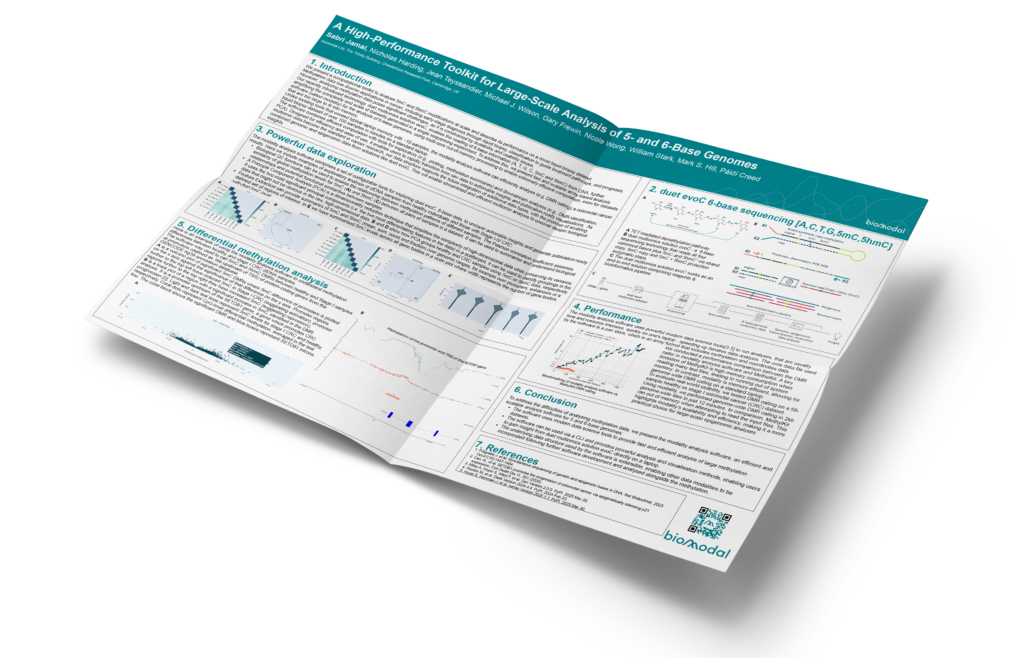
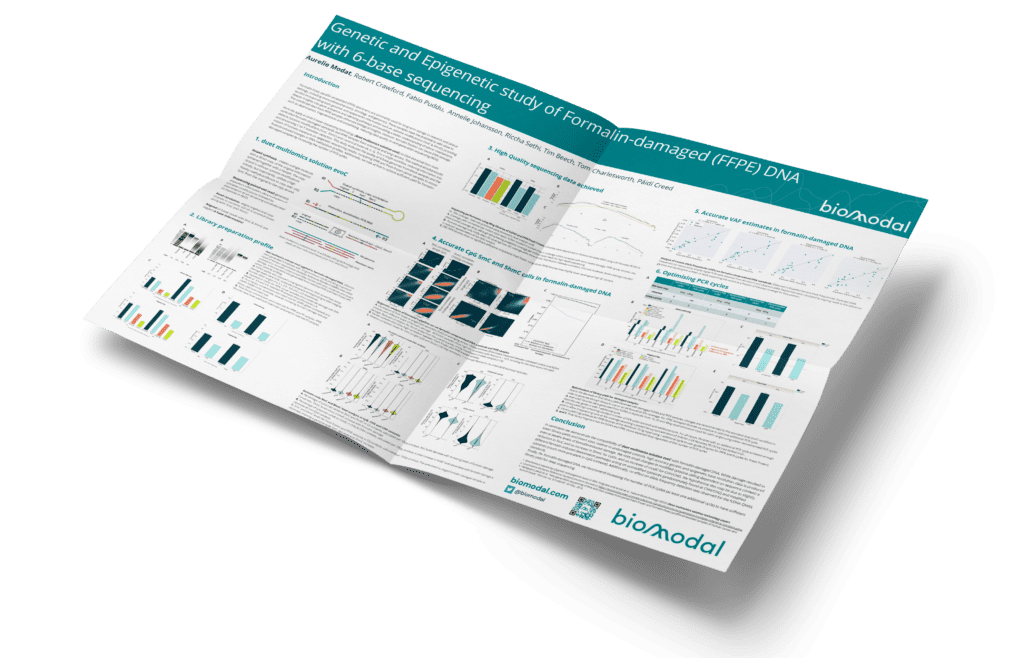
Here are the relevant biomodal resources for information. Find poster presentation information, case studies, interviews, and more.

Related resources

Attending from biomodal

Padhu Srini, PhD

Territory Account Manager, US West
Steven Ciaramaglia

Steven Ciaramaglia

US Territory Manager, Northeast
Thao Huynh

Thao Huynh

Scientific Affairs Partner

Register now

Meet our team at the event

Canadian Conference on Circulating Biomarkers 5-6JUN26
123456789

Stay up to date

Explore recent biomodal news and the events that we’ll be attending in the near future.

What are you looking for?