Neuroscience 2025

Reveal the power of the 6-base genome.
15 November 2025
to 19 November 2025
San Diego Convention Center
, San Diego
, United States of America

Visit biomodal at booth 

#1020

About the event

Each year, scientists from around the world congregate to discover new ideas, share their research, and experience the best the field has to offer. Attend so you can: present research, network with scientists, attend session and events, and browse the exhibit hall.

Join the nearly half a million neuroscientists from around the world who have propelled their careers by presenting an abstract at an SfN annual meeting — the premier global neuroscience event.  

Presenting at the event

Revealing the power of the 6-base genome to uncover epigenetic mechanisms in neuronal disease

Mark Consugar

Associate Director of Scientific Affiars

biomodal

Monday, November 17, 2025 | 4:00 PM | Product Theater #1, 1200 Aisle (Exhibit Hall)

Neuronal tissues contain significantly higher levels of the epigenetic DNA modification 5hmC compared to other tissues. Changes in methylation state between unmodified cytosine, 5mC & 5hmC have been shown to have a significant impact on disease initiation & progression. Here researchers will share how the 6-base genome (A, C, T, G, 5mC & 5hmC) is revealing previously invisible biology by providing accurate 5mC & 5hmC data alongside complete genetic information from brain tissue & cfDNA samples.

Tracking neuronal damage in neurological conditions with 6-base sequencing of cell-free DNA

Chiara Starvaggi Cucuzza

MD

Karolinska Institutet, Clinical Neuroscience

Monday, November 17, 2025 | 4:00 PM | Product Theater #1, 1200 Aisle (Exhibit Hall)

Degenerative processes during Multiple Sclerosis (MS) progression are scarcely captured by currently available soluble biomarkers, hindering treatment development. Damaged and dying neurons release DNA fragments into extracellular biological fluids (cell-free DNA, cfDNA), where DNA methylation signature of the cell of origin is retained. Our aim is to utilize this epigenetic signature, including neuronal-specific DNA hydroxymethylation (hmC), in cfDNA from cerebrospinal fluid (CSF) to detect ongoing central nervous system (CNS) cell damage in MS and other neurological diseases.
We successfully generated sequencing libraries from ultralow input (<1 ng) of CSF cfDNA using 6-base sequencing (duet evoC by biomodal Limited) in a cohort of healthy controls and people with MS, amyotrophic lateral sclerosis, narcolepsy type 1, extrapiramidal degeneration or traumatic brain injury (TBI). Higher neuronal DNA content as identified by hmC was evident in TBI CSF cfDNA. Restricting the analysis to neuronal-relevant DNA regions, hmC signal was able to separate HC from neurological conditions, including MS.

Poster Presentation: Mapping the human cerebellum with 6-base sequencing

Thao Huynh

Scientific Affairs Partner

biomodal

Session Name: Spatial Mapping of Brain Changes in Aging | PSTR010.17 / C48 | Saturday, November 15, 2025, 1:00 PM – 5:00 PM | Presenter at Poster 1:00 PM - 2:00 PM

The human brain exhibits unique epigenetic features that support its highly specialized roles in information processing, motor control, consciousness, learning, and memory. In particular, 5-hydroxymethylcytosine, also known as the sixth DNA base of the genome, is known to be significantly enriched in many cells found in brain tissue. Here, we apply 6-base sequencing, an assay capable of simultaneously detecting all four canonical DNA bases along with two key epigenetic modifications—5-methylcytosine (5mC) and 5-hydroxymethylcytosine (5hmC)—to comprehensively profile the cerebellar epigenome. We generated a high-resolution 5-methylome and 5-hydroxymethylome profile from post-mortem human cerebellum and compared this to profiles from a panel of non-brain tissues, including liver, lung, and breast. Our analysis reveals that the cerebellum harbors a distinct epigenetic signature characterized by widespread 5hmC enrichment at neuronal gene bodies and enhancer regions, consistent with active transcriptional regulation. These findings demonstrate the power of 6-base sequencing to resolve tissue-specific epigenetic landscapes and underscore the cerebellum’s unique regulatory architecture. This approach provides a valuable framework for understanding brain-specific gene regulation and its disruption in neurological disease.

Customer Poster Presentation: Identifying DNA methylation signatures in cell-free DNA from cerebrospinal fluid to detect nervous system cell damage in multiple sclerosis and other neurological diseases.

Chiara Starvaggi Cucuzza

MD

Karolinska Institutet, Clinical Neuroscience

Session Name: Multiple Sclerosis and Neurodegeneration: Viral, Immune, and Therapeutic Approaches | PSTR166.20 / K2 | Monday, November 17, 2025, 8:00 AM – 12:00 PM | Presenter at Poster 11:00 AM - 12:00 PM

The human brain exhibits unique epigenetic features that support its highly specialized roles in information processing, motor control, consciousness, learning, and memory. In particular, 5-hydroxymethylcytosine, also known as the sixth DNA base of the genome, is known to be significantly enriched in many cells found in brain tissue. Here, we apply 6-base sequencing, an assay capable of simultaneously detecting all four canonical DNA bases along with two key epigenetic modifications—5-methylcytosine (5mC) and 5-hydroxymethylcytosine (5hmC)—to comprehensively profile the cerebellar epigenome. 

We generated a high-resolution 5-methylome and 5-hydroxymethylome profile from post-mortem human cerebellum and compared this to profiles from a panel of non-brain tissues, including liver, lung, and breast. Our analysis reveals that the cerebellum harbors a distinct epigenetic signature characterized by widespread 5hmC enrichment at neuronal gene bodies and enhancer regions, consistent with active transcriptional regulation. 

These findings demonstrate the power of 6-base sequencing to resolve tissue-specific epigenetic landscapes and underscore the cerebellum’s unique regulatory architecture. This approach provides a valuable framework for understanding brain-specific gene regulation and its disruption in neurological disease. 

Poster Presentation: Simultaneous single cell sequencing of genetic and epigenetic bases

Mark Consugar

Associate Director of Scientific Affairs

biomodal

Session Name: Spatial and Multi-omics II | PSTR417.11 / TT5 | Wednesday, November 19, 2025, 8:00 AM – 12:00 PM | Presenter at Poster 10:00 AM - 11:00 AM

A growing body of evidence highlights the critical role of epigenetic modifications in shaping neural identity and function. In the brain, where cellular diversity and plasticity are paramount, DNA modifications such as 5-methylcytosine (5mC) and 5-hydroxymethylcytosine (5hmC) serve as key regulators of gene expression. These cytosine modifications influence neuronal development, synaptic plasticity, and are implicated in a range of neurological disorders. While 5mC is traditionally associated with gene repression, 5hmC—particularly enriched in neuronal tissues—is increasingly recognized as a marker of active gene regulation and enhancer activity.

Despite their importance, resolving the distribution and interplay of 5mC and 5hmC at single-cell resolution in the brain has remained a major technical challenge. We present a single nuclei workflow to simultaneously determine 5mC and 5hmC at the single molecule level, based on an existing bulk assay for simultaneous measurement of genetics, 5mC, and 5hmC.

Applying this method to mouse cortical tissue, we identified multiple neural cell populations based on their unique 5mC and 5hmC landscapes. Integrating this data with existing single-cell ATAC-seq and RNA-seq atlases, we were able to see distinctive patterns of 5mC and 5hmC marking expressed genes. These findings underscore the power of single-cell epigenomic profiling to uncover hidden regulatory diversity in the brain.

Find the venue

One sample. One workflow. One solution.

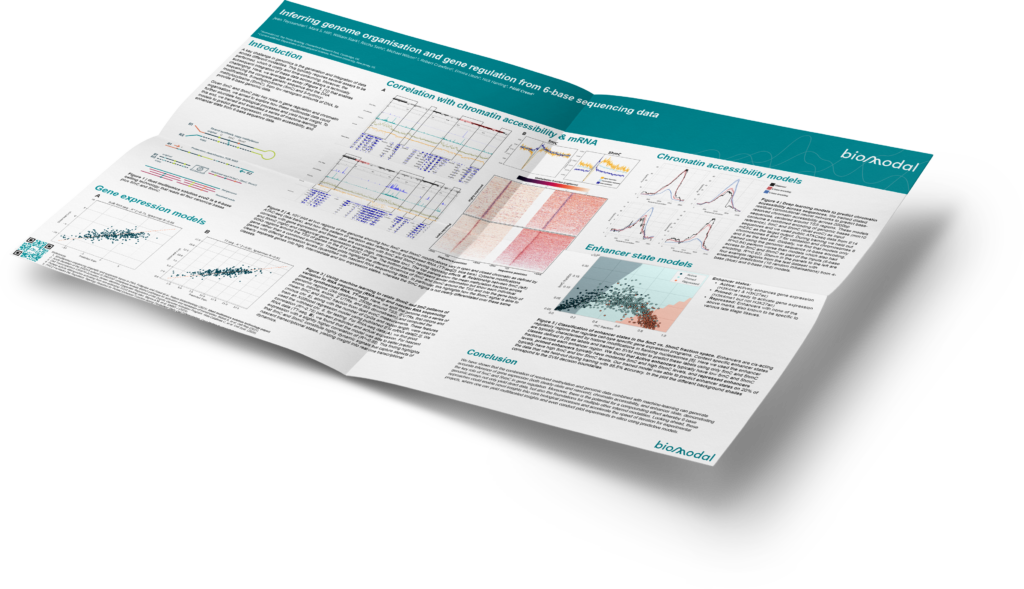
Here are the relevant biomodal resources for information. Find poster presentation information, case studies, interviews, and more.

Related resources

Attending from biomodal

Craig Fishman

Craig Fishman

Regional Head of Sales, North America
Brett Evans

Brett Evans

US Territory Manager, Midwest
Gianina LaChapelle

Gianina LaChapelle

Regional Marketing Manager
Kurt Yardley

Kurt Yardley

Director of Global Marketing
Mark Consugar

Mark Consugar

Associate Director of Scientific Affairs
Jen Stone

Jennifer L. Stone, PhD

Vice President, Business Development and Customer Solutions

Register now

SFN 2025
276257088757

Stay up to date

Explore recent biomodal news and the events that we’ll be attending in the near future.

What are you looking for?