duet software
From raw reads to
the complete picture
Turn duet sequencing data into the complete 6-base genome: resolved genetics with variant calls, independent 5mC and 5hmC, and fragmentomics from the same molecules. A transparent, fully documented pipeline designed to integrate into your existing genetic and epigenetic workflows, with quality control in every run, on your own compute. Included with every duet kit.
Analysis isn’t an add-on. It’s part
of duet.
Multiomic data is only as good as the analysis behind it. Every duet kit includes duet software, so you can go from FASTQ files to analysis-ready genetic, epigenetic and fragmentomic data, while preserving the relationships between them, for downstream analysis in modality XPLR.
duet software is built around duet’s hairpin chemistry. It provides complete genetic and epigenetic information in a unified 6-base output, by resolving the four canonical genetic bases, and the distinct epigenetic marks, 5mC and 5hmC, from duet paired-end reads. duet software aligns resolved reads to a standard 4-base genome, calls variants and quantifies methylation, producing outputs that fit straight into your standard downstream genomics workflows. Read resolution also suppresses sequencing and PCR errors, reporting them as Ns, before they reach your results.
Every step uses documented methods. Every run is checked against the controls in every kit. Every output is a community-standard file that fits your existing genetic and epigenetic workflows, generated on your own compute so your data stays yours.
duet assay
Library prep
Short-read sequencing
Platform-agnostic; outputs FASTQ files
Read resolution
Resolved FASTQ: genetics with 5mC and 5hmC as MM tags; errors flagged as N
Alignment
Any standard four-base aligner
BAM
Source for variants, methylation and fragmentomics
Standard variant calling from the BAM, including C>T
Controls checked in every sample
Methylation and fragmentomics, ready for modality XPLR
modality XPLR
Explore methylation and fragmentomics on a laptop
duet assay
Library prep
Short-read sequencing
Platform-agnostic; outputs FASTQ files
Read resolution
Resolved FASTQ: genetics with 5mC and 5hmC as MM tags; errors flagged as N
Alignment
Any standard four-base aligner
- BAM
BAM
Source for variants, methylation and fragmentomics
Standard variant calling from the BAM, including C>T
Controls checked in every sample
Methylation and fragmentomics, ready for modality XPLR
modality XPLR
Explore methylation and fragmentomics on a laptop
Why duet software?
Included with every kit. Run it your way.
duet software and modality XPLR come with every duet kit. You choose where it runs, on your own HPC cluster or cloud account, and how you analyze the results. Your data stays in your environment, and a built-in test dataset verifies every installation. Setup is simple and fully supported.
Quality control in every run
Every run is checked for sequencing and library performance, genetic accuracy and epigenetic accuracy, using the controls that are included with every kit. Intuitive reports confirm assay and sequencing performance before you start your analysis.
Read resolution delivers unified 6-base data, with accuracy built in
Read resolution uses raw FASTQ files to compare original and copy strand sequences from each duet construct, combining them into a single resolved read with the genetic and epigenetic status at each base. The software outputs aligned BAM files in standard four-letter space, with epigenetic calls as MM tags. This preserves C>T variant calling performance, and filters out sequencing and PCR errors.
Variant calling, germline and somatic
Germline SNVs and indels are called with GATK HaplotypeCaller by default, or with a duet-optimized DeepVariant. Joint genotyping across samples and optional tumor-only somatic calling are also available. Results are delivered as standard (g)VCF files. duet provides complete epigenetics without compromising the genetics, so you can run your existing genetics workflows on a single duet dataset: one sample, one workflow.
Analysis-ready methylation and fragmentomics data
Methylation counts and fragmentomics data are packaged in analysis-ready formats: multi-sample Zarr stores compatible with modality XPLR, or plain-text files for integration into your existing workflows. How you analyze your data is up to you.
Link genetics to epigenetics with allele-specific methylation
Every read contains both genetic and epigenetic information, so the two can be linked. The optional allele-specific methylation (ASM) module separates reads by allele at heterozygous variants and compares methylation between them, with a statistical test for confidence. The result connects each variant to the methylation pattern on its own allele, from the same molecules and the same run.
Workflow
From FASTQ to analysis-ready 6-base data
One workflow handles every duet assay. Start from the FASTQ files from your sequencer and finish with resolved, quality-checked data in standard formats.
Step 1 · Read resolution
Complete genetics and complete epigenetics on a single resolved read.
What happens
- Trims reads and records the original fragment length.
- Pairs original and copy strands, then applies duet’s resolution rules to call the original genetic and epigenetic bases.
- For 6-base data, distinguishes 5mC from 5hmC at CpG sites.
- Suppresses PCR and sequencing errors.
Outputs
- Resolved reads in a standard four-letter alphabet, with epigenetic calls in MM tags.
Why it matters: Genetics and epigenetics on the same single read, so a C>T variant and methylation are each called correctly, and errors are removed before alignment.
Step 2 · Alignment and deduplication
Standard alignment, smarter duplicate removal.
What happens
- Aligns resolved reads against your nominated reference genome plus the spike-in control sequences.
- Encodes epigenetic calls into BAM files as MM tags.
- Merges lanes per sample and removes duplicates. Fragment-length-aware deduplication keeps distinct molecules that would otherwise be discarded.
- Filters secondary, supplementary and low mapping-quality reads.
Outputs
- Deduplicated BAM files or optional CRAM files.
Why it matters: Resolved reads use the standard four-letter alphabet, increasing alignment efficiency. Fragment-length-aware deduplication increases the proportion of usable bases, increasing coverage, which matters most when input is limited.

Step 3 · Methylation quantification
Independent 5mC and 5hmC at every CpG.
What happens
- Counts modification state at every CpG in the reference genome, for samples and controls.
- For 6-base data, reports 5mC and 5hmC separately, which can be used to report total modified C.
- Optionally quantifies modified C at CHG and CHH sites.
- Optional hmC quality filtering removes low-confidence 5hmC calls.
Outputs
- A multi-sample Zarr store with every CpG in every sample, ready for modality XPLR.
- Per-sample cytosine reports by default, with optional bedMethyl, bedGraph and Bismark formats.
Why it matters: Combining independent 5mC and 5hmC is what drives 6-base performance. The pipeline delivers both as separate, quantified signals, ready for analysis.
Step 4 · Variant calling and variant-associated methylation
Genetics from the same molecules, alongside 5mC and 5hmC.
What happens
- Calls germline SNVs and indels with GATK HaplotypeCaller by default, or with DeepVariant using a model trained on duet data.
- Supports joint genotyping across samples.
- Optionally calls somatic variants with GATK Mutect2 in tumor-only mode, with recommended filtering.
- Optionally quantifies allele-specific methylation (ASM): reads are split by allele at heterozygous variants and methylation is compared.
Outputs
- VCF files (per sample or joint), optional somatic VCFs and ASM files.
Why it matters: Because the copy strand preserves the genetic sequence, C>T variants are called with confidence alongside methylation from the same molecules, so you can link genetic and epigenetic changes directly.

Step 5 · Fragmentomics
Fragment length and end motifs, with epigenetic context.
What happens
- Measures the fragment-length distribution and the motifs at the 5′ end of every fragment.
- Records end motifs in the 6-base alphabet for 6-base data, so motifs carry their 5mC and 5hmC state as well as sequence.
- Combines all samples into one fragmentomics Zarr store that loads directly into modality XPLR for analysis and visualization. Plain-text exports are available on request.
- Can be generated from existing duet BAM files without reprocessing from FASTQ.
Outputs
- Multi-sample fragmentomics Zarr store; optional per-sample fragment-length and end-motif tables.
Why it matters: Fragmentation is another layer of biology carried by every cfDNA molecule. duet preserves native fragment ends, so you get genetics, 5mC, 5hmC and fragmentomics from the same data and the same run.

Step 6 · Quality control and reports
Confidence before interpretation.
What happens
- Measures sensitivity and specificity on the methylated and unmethylated controls in every sample, plus genetic accuracy.
- Reports resolution, trimming, alignment, duplication, coverage, GC bias, M-bias and TSS enrichment metrics.
- Collates everything into an interactive HTML summary, per-sample CSV reports and a MultiQC report.
Outputs
- Run-level and per-sample QC reports.
Why it matters: Clear QC data tell you whether library prep and sequencing worked, sample by sample, before you invest time in analysis.
Your data is processed. Now find the biology.
modality XPLR takes the Zarr stores from duet software straight into biological QC, differential methylation analysis, feature extraction and fragmentomic exploration, on a standard laptop.
duet compatibility
One pipeline. Every duet assay.
duet software processes data from every duet assay, adapting trimming, resolution and quality control to each chemistry.
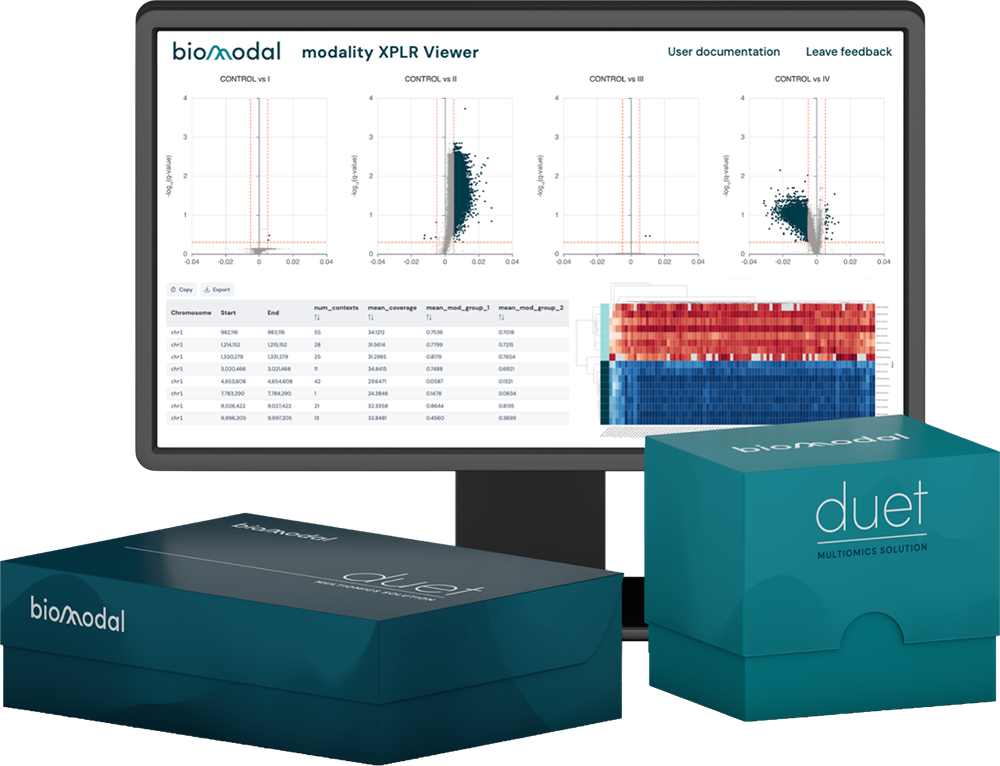
duet 6-base mosaic
- Sample type
- cfDNA
- Genetics
- Reported
- Epigenetics
- 5mC and 5hmC at CpGs; modified C at other contexts
- Fragmentomics
- Reported
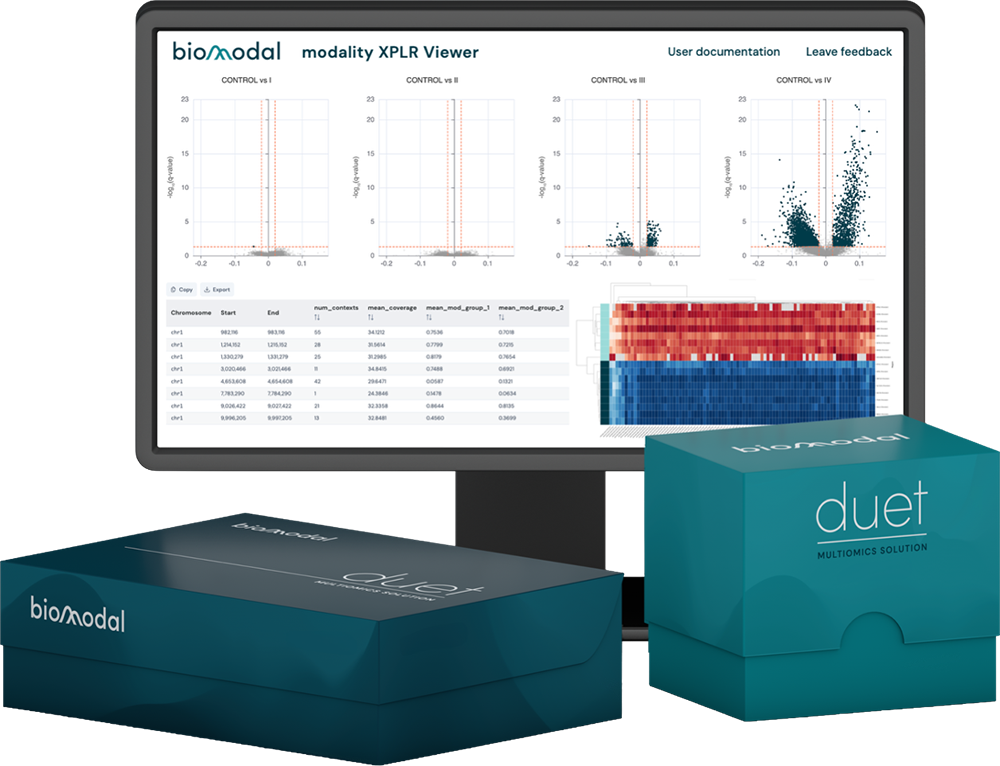
duet +modC mosaic
- Sample type
- cfDNA
- Genetics
- Reported
- Epigenetics
- Modified C
- Fragmentomics
- Reported
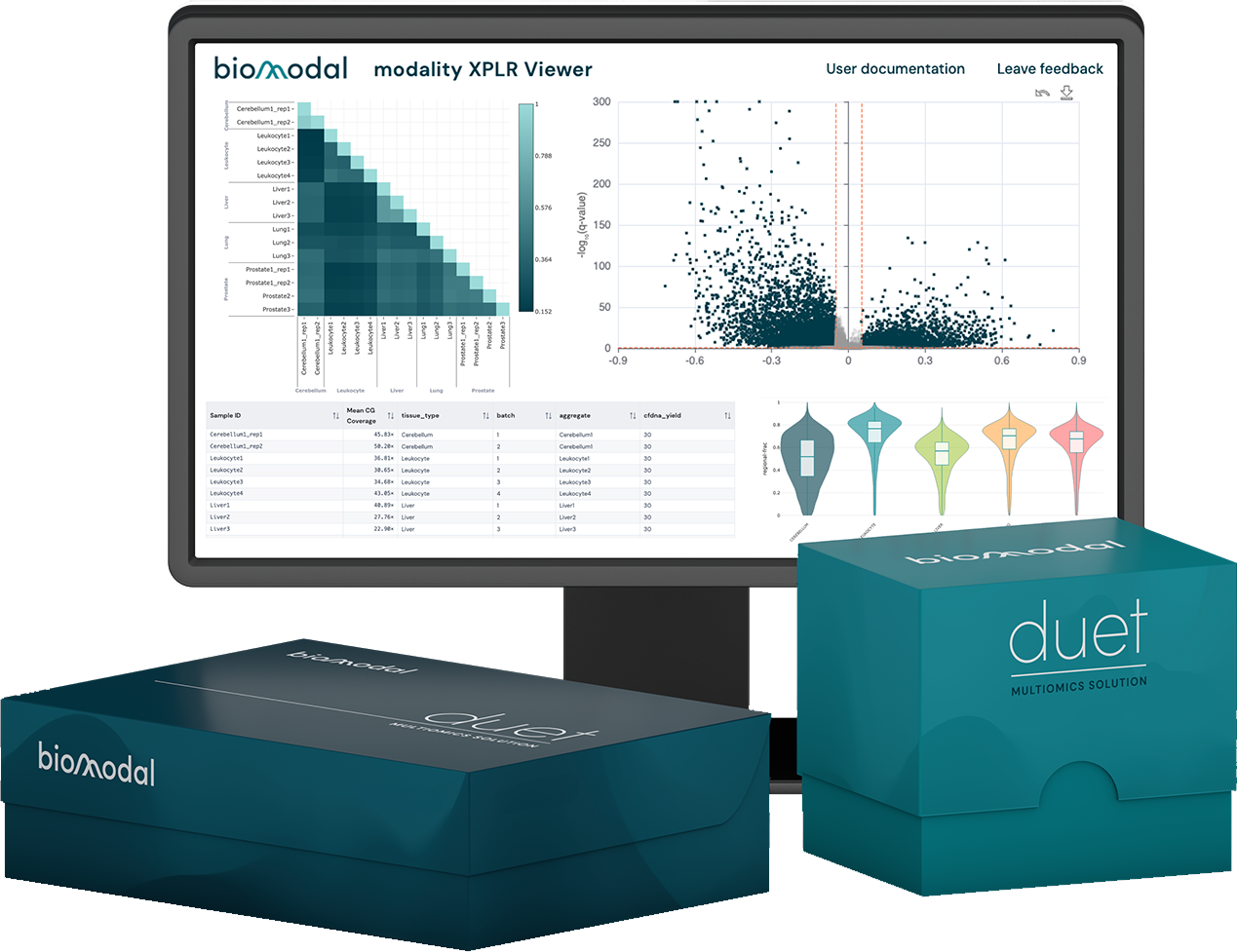
duet evoC
- Sample type
- gDNAFFPEcfDNA
- Genetics
- Reported
- Epigenetics
- 5mC and 5hmC at CpGs; modified C at other contexts
- Fragmentomics
- Reported
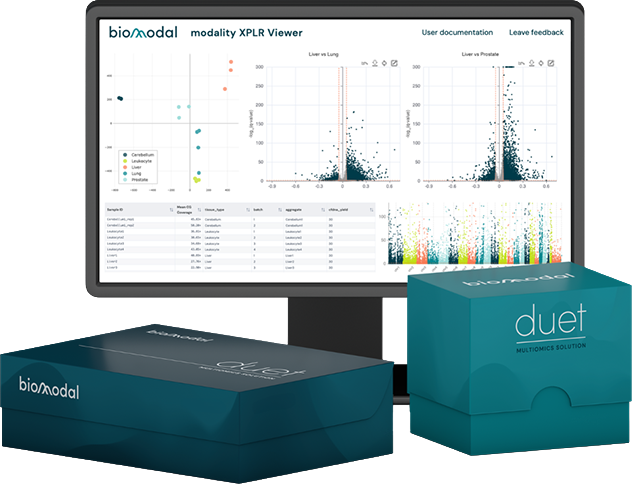
duet +modC
- Sample type
- gDNAFFPEcfDNA
- Genetics
- Reported
- Epigenetics
- Modified C
- Fragmentomics
- Reported
For mosaic assays, single-stranded ligation avoids end repair, so the pipeline keeps methylation calls right to the fragment end and preserves native fragment ends for fragmentomics.
Specifications
Standard format outputs, run on your infrastructure.
duet software runs on your own HPC cluster or cloud account and writes community-standard files compatible with IGV, samtools, GATK, methylKit, Bismark tools, R, Python or modality XPLR. You install it once with a command-line tool; after that, analyses run with minimal technical involvement. Your sequencing data stays in your environment.
Outputs
| Output | What it contains | Use it with |
|---|---|---|
| BAM or CRAM | Deduplicated alignments with methylation in standard MM tags and original fragment length | IGV, samtools, pysam, GATK |
| VCF | Germline SNVs and indels (per sample or joint); optional somatic calls | IGV, GATK and other standard VCF tools |
| Methylation files | Per-CpG counts for 5mC, 5hmC and modified C. Cytosine report by default; bedMethyl, bedGraph and Bismark on request | IGV, methylKit, Bismark tools, R, Python |
| Zarr stores | Multi-sample methylation and fragmentomics data in a compressed format built for large cohorts | modality XPLR |
| ASM file | Allele-specific methylation at heterozygous variants, with p-values | R, Python, command-line tools |
| Fragmentomics tables | Per-sample fragment-length and end-motif counts (optional) | R, Python |
| QC reports | Excel and CSV summary with definitions, interactive HTML, per-sample and MultiQC reports | Any browser or spreadsheet |
Your data. Your compute. Your choice.
Run duet software on your own HPC cluster or in your own cloud account.
| Compute environments | HPC clusters (SLURM, LSF, SGE, PBS); AWS Batch; Google Cloud Batch. |
|---|---|
| Requirements | Linux; Bash 4+; Java 17 to 24; Docker, Apptainer or Singularity |
| Orchestration | Nextflow, with containerized modules |
| Inputs | Paired-end FASTQ files, or existing duet BAM files; optional sample metadata sheet (same format as modality XPLR) |
| Sequencers | Illumina NovaSeq 6000, NovaSeq X, NextSeq 1000 and 2000; Element AVITI |
| Scale | Resource profiles for up to 50 million, up to 500 million and over 500 million reads per sample per lane |
| Reference genomes | Human GRCh38 (default), hg19 and T2T-CHM13v2; mouse GRCm39 and GRCm38p6; rat; cow; sheep; zebrafish; human-mouse PDX. Build your own with the reference genome pipeline. |
| Targeted sequencing | Twist Alliance Pan-cancer Methylation Panel and Twist Human Methylome Panel supported out of the box; other panels supported with your own bait and target files |
| Data privacy | Runs in your environment. Optional, opt-in telemetry shares usage events and run metrics only. |
| Getting started | Built-in test dataset to verify your installation (typically 30 to 60 minutes) |
| Updates | Download new versions with one command; keep previous versions installed |
Documented in full. Supported by experts.
- Quick-start guides for lab scientists and bioinformaticians
- Installation and running guide for HPC and cloud, with guidance for system administrators
- Data interpretation guide explaining pipeline outputs
- Release notes for every pipeline and CLI version
- Public demo datasets (Genome in a Bottle) to explore real duet data before your first run
- Expert support from biomodal’s product support team
FAQs
Yes. duet software and modality XPLR are included with every duet kit. You run the software on your own compute resources.
duet software processes your sequencing data into resolved genetics with variant calls, methylation and fragmentomics, with QC, on HPC or cloud. modality XPLR takes those outputs and helps you explore the biology, including biological QC, differential methylation and feature extraction, on a standard laptop.
A Linux HPC cluster (SLURM, LSF, SGE or PBS) or an AWS or Google Cloud account, with Java and a container engine (Docker, Apptainer or Singularity). Your system administrator installs it once; after that, analyses run with minimal technical involvement.
Yes. The pipeline runs in your environment. Sharing usage events and run metrics with biomodal is optional and opt-in, and covers those metrics only.
All duet assays: duet 6-base mosaic, duet evoC, duet +modC mosaic and duet +modC. Data from Illumina NovaSeq 6000, NovaSeq X, NextSeq 1000 and 2000, and Element AVITI are supported.
Every kit includes methylated and unmethylated controls. The pipeline measures them in every sample and reports sensitivity, specificity and genetic accuracy against pass thresholds, alongside alignment, coverage and duplication metrics, in Excel, HTML and MultiQC reports.
Yes. Outputs use community-standard formats: BAM or CRAM with standard MM tags, VCF, and bedMethyl, bedGraph, Bismark or cytosine report files. They work with tools such as IGV, samtools, GATK and methylKit.
Yes. Reference genomes for human and mouse are included, or you can provide your own. Twist Methylome and Pan-Cancer panels are compatible out of the box, in addition to custom designs.
Install updates via the biomodal CLI to maintain version control. Release notes are published for every version.
Ready to trust your data?
Talk to our team about running duet software in your environment.