- Aurélie Modat¹
- Luke Sarre¹
- Cillian Nolan¹
- Annelie Johansson¹
- Fabio Puddu¹
- Angela Simeone¹
- Rob Crawford¹
- Mike Stubbington¹
- Rob Osborne¹
1 biomodal Ltd, The Trinity Building, Chesterford Research Park, Cambridge, UK
Circulating cell‑free DNA (cfDNA) contains rich genetic, epigenetic, and structural information for cancer detection, but its highly fragmented nature, low abundance, and high background noise make reliable detection of circulating tumour DNA (ctDNA) challenging. Conventional double‑stranded DNA (dsDNA) workflows rely on end repair and A tailing (ERAT), which lose damaged or ultra‑short molecules and introduce artifacts, limiting sensitivity and increasing the limit of detection (LoD).
biomodal’s duet mosaic workflow is optimised for cfDNA, capturing damaged and ultra‑short fragments by ligating adapters directly to single‑stranded molecules without ERAT. High material recovery combined with high accuracy 6‑base sequencing enables accurate and specific variant and methylation calling, improving reproducibility and lower LoD. duet 6-base mosaic improves the phased multiomic readout from the same molecules, including genetic variants, independent 5mC and 5hmC, and native fragmentomic features, reducing false negatives and improving confident detection of ctDNA.
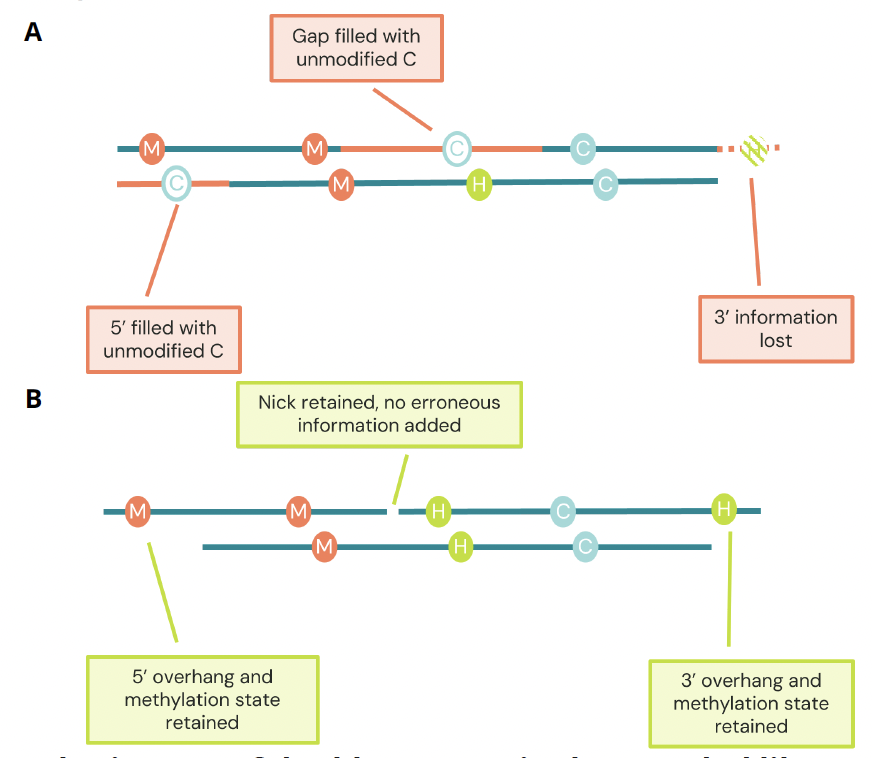
Fig. 1 Molecular impact of double versus single stranded library preparation. (A) Double-stranded ligation and ERAT is error-prone and introduces unmodified cytosines not present in cfDNA. (B) Single- stranded ligation retains original cfDNA features, with no false information introduced through DNA synthesis.
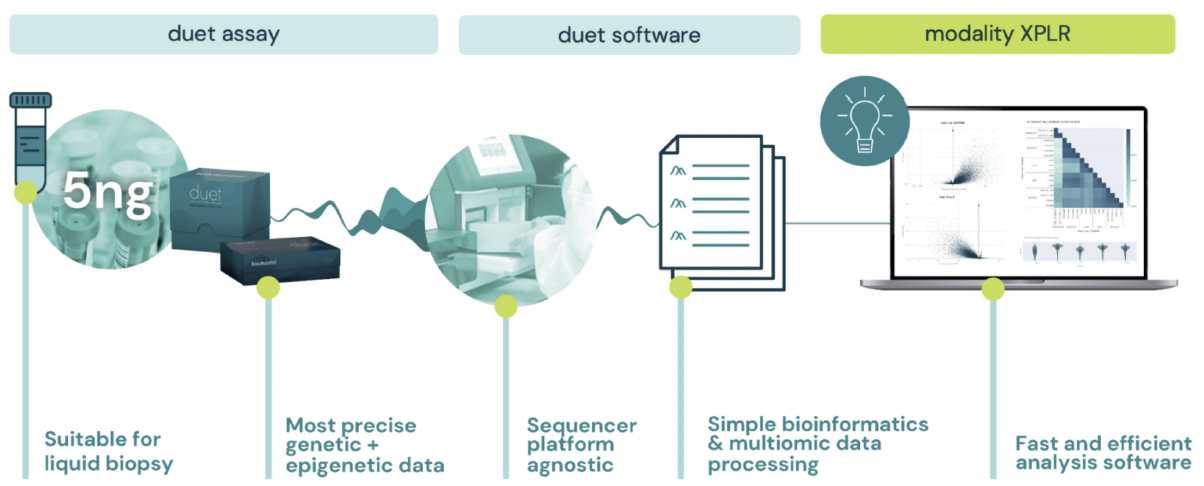
Fig. 2 The duet mosaic workflow provides complete end-to-end solutions for liquid biopsy applications. The workflow includes: the duet mosaic assay, duet software and the modality XPLR software toolkit, designed for accessible, scalable analysis of 5 and 6-base data.
2. duet mosaic has market leading methylation and genetic accuracy, including detection of C>T variants
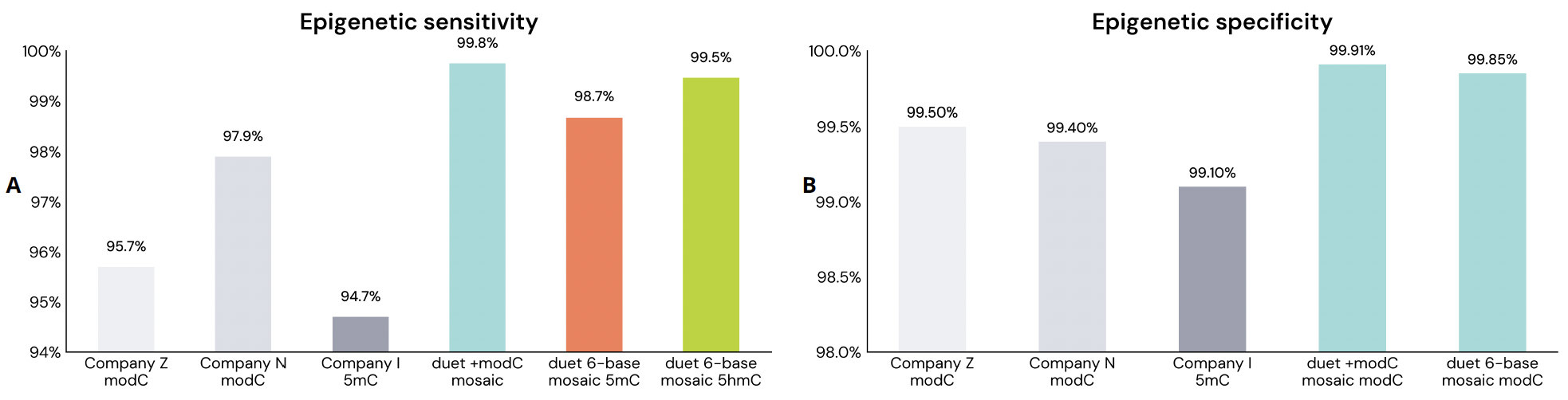
Fig. 3 duet mosaic methylation sensitivity (A) and specificity (B) compared to other epigenetic sequencing technologies. For duet mosaic, sensitivity and specificity are assessed using methylated pUC19 control and unmethylated lambda controls that are included in the every kit. 5hmC sensitivity is calculated using the included short oligo controls. For other sequencing technologies publicly available data was used ⁴. duet mosaic has a 6-9 fold lower number of false positives than company I whilst achieving higher sensitivity to recover the real methylation signal.
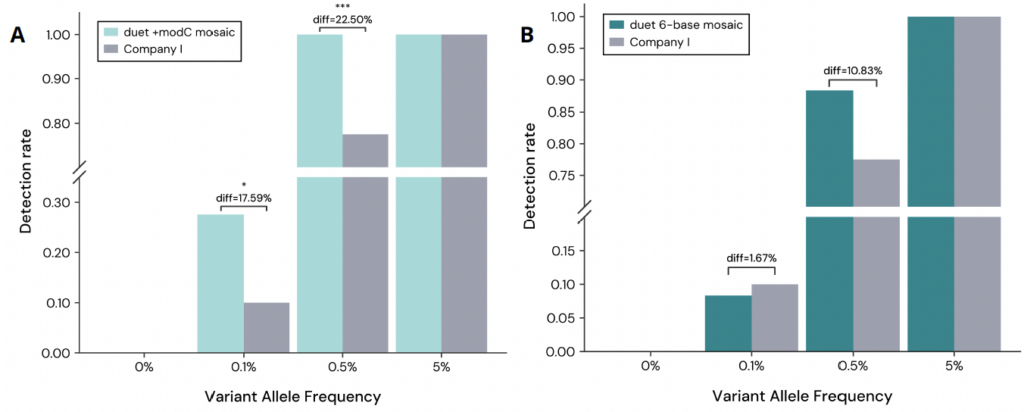
Fig. 4. duet mosaic detects more of the most common C>T/G>A variations. Contrived spike in samples were created using Seracare reference materials and C>T calling assessed using deep sequenced targeted data. A typical tumour contains >300 C>T mutations⁵, which may be present at low VAF in cfDNA, highlighting the importance of high detection performance at 0.5% VAF.
3. duet mosaic captures shorter fragments and maintains high fidelity fragmentomic information
Table. 1 Quantification of short cfDNA fragments (below ~145bp) Short cfDNA fragments are known to be enriched in ctDNA³. duet 6- base mosaic captures more short fragments than a conventional ERAT workflow.
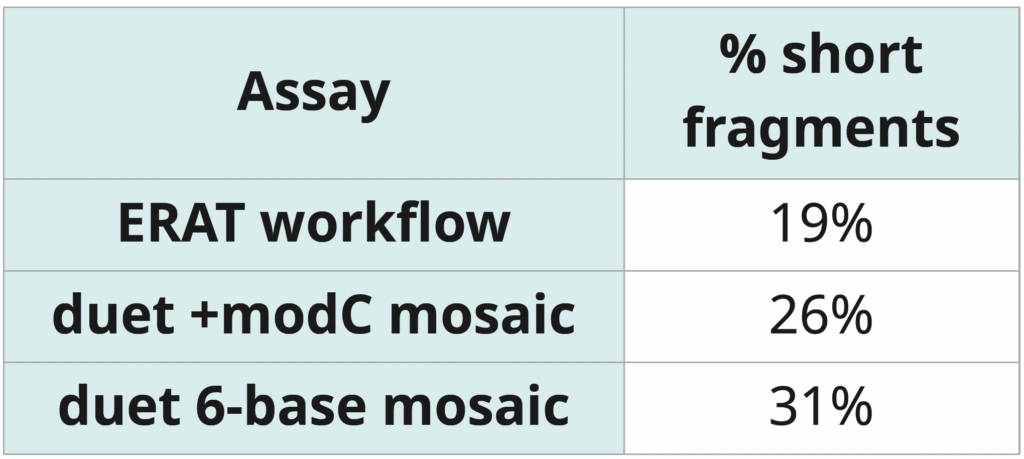
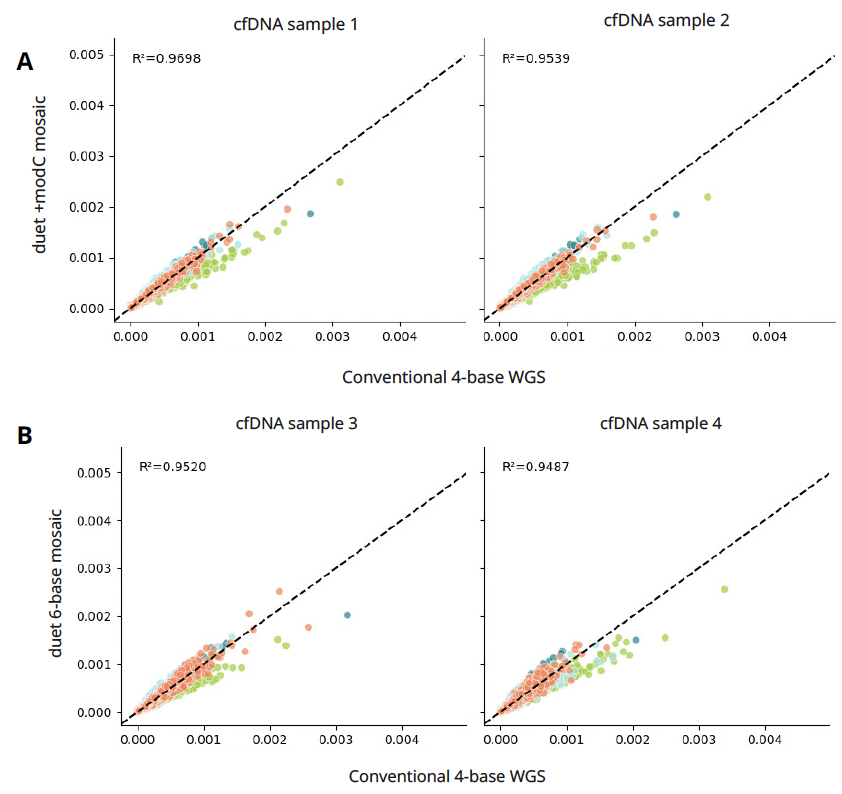
Fig. 5 cfDNA end motif frequencies strongly correlate with WGS 95% agreement between duet +modC mosaic ( A ) and duet 6- base mosaic ( B ) and whole‑genome sequencing (WGS) from matched clinical cfDNA samples when comparing the frequency of calling A (dark teal), T (coral), G (light teal) or C (green) at the 5′ fragment end. With duet 6-base mosaic you can extend end motifs to be 5mC and 5hmC aware, increasing the biomarkers space from 256 to 4,096, enabling higher granularity and improving classifier performance ¹˒².
4. duet mosaic enables ultra‑low LoD through combined genetic and methylation information
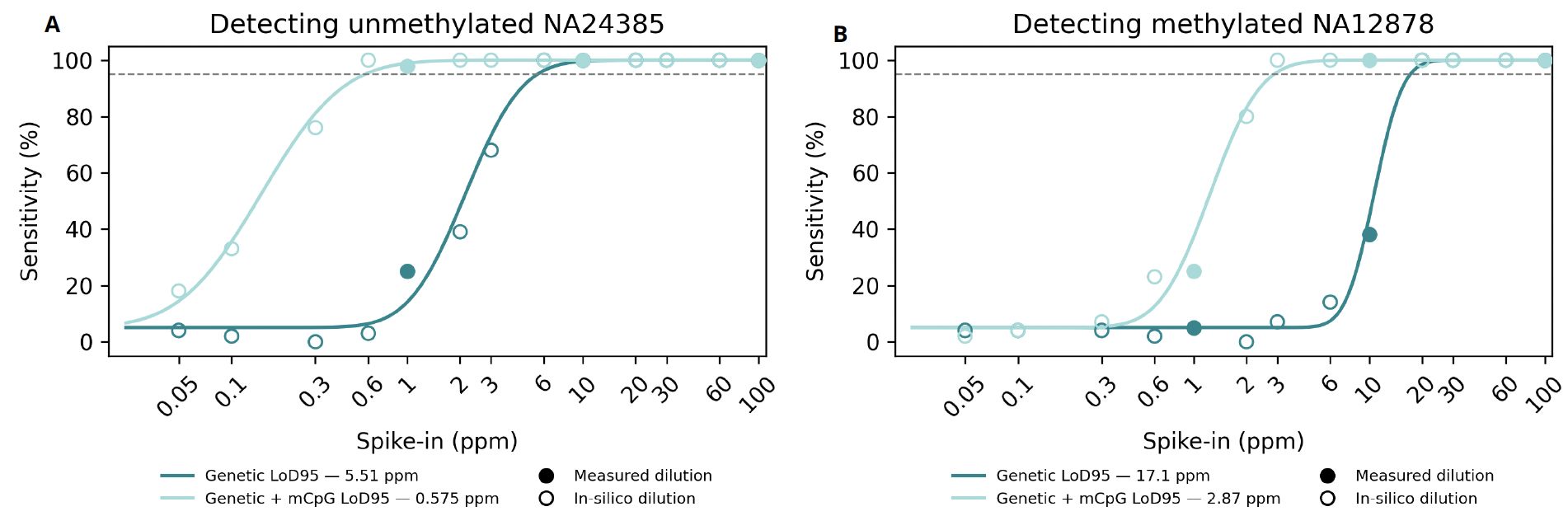
Fig. 6 duet 6-base mosaic LoD is improved through use of integrated genetic and methylation information from the same cfDNA fragment LoD95 was evaluated using Seraseq Unmethylated ctDNA Mutation Mix (NA24385) and methylated NA12878 alone or in spike in dilutions (1, 10 and 100 ppm). The two genomes differ at 6,366 homozygous SNVs, targeted using a 1Mb sequencing panel. Experimental dilutions were complemented by 4M-read in-silico mixtures at additional concentrations, generated by subsampling. Evidence for methylated NA12878 or unmethylated NA24385 was assessed using joint read-level methylation and SNV information or SNV information alone. LoD95 was estimated by probit regression (95% specificity). Combining genetic and epigenetic signal at single read-level enables an order of magnitude lower LoD compared to genetics alone, enhancing ctDNA detection capabilities.

Fig. 7 The majority of SNVs in late stage colorectal cancer (CRC) cfDNA have diff erential methylation on the same read Tumour- associated SNVs were identified from matched tumour/normal samples from a Stage IV CRC patient (SNV calls and matched cfDNA provided by NeoGenomics). Following 6- base profiling of the cfDNA, reads at each SNV were stratified into ALT (tumor variant indicating a ctDNA fragment) and REF (reference allele, background cfDNA). Read-level methylation diff ered between ALT and REF molecules at 54% of SNVs, predominantly through hypomethylation on ALT reads (n = 1,683; hypermethylated n = 72). Thus, thousands of loci carry co-occurring genetic and methylation signals on the same ctDNA molecule, providing opportunities for the 6-base genome to improve ctDNA detection and lower LoD versus genetics alone.
Sensitive ctDNA detection requires high analytical performance to reliably detect tumour‑derived signals at very low prevalence. duet mosaic achieves ultra‑low limits of detection by combining high material recovery with outstanding sensitivity and specificity across genomic and epigenetic features:
- Better capture of short cfDNA molecules that are enriched in ctDNA.
- Market-leading methylation sensitivity, enabling detection of the most challenging biomarkers while maintaining exceptionally low false positive rates.
- Complete SNV detection including common C>T variants.
- The ability to combine common combined genetic and methylation changes on the same DNA fragment to lower LoD by an order of magnitude.
- Zhou, Q. et al. Epigenetic analysis of cell- free DNA by fragmentomic profi ling. Proc. Natl. Acad. Sci. U. S. A. 119 , e2209852119 (2022).
- Abstract 122: Using the 6- base genome for full multiomic analysis of cfDNA through combined methylation and fragmentomic analysis to enhance classifi cation of clinical cancer cfDNA samples. | Cancer Research | American Association for Cancer Research. https://aacrjournals.org/cancerres/article/86/7_Supplement/122/775973.
- Mouliere, F. et al. Enhanced detection of circulating tumor DNA by fragment size analysis. Sci. Transl. Med. 10 , eaat4921 (2018).
- https://www.illumina.com/science/genomics- research/articles/5- base- solution.html
- Alexandrov, L. B. et al. The repertoire of mutational signatures in human cancer. Nature 578 , 94–101 (2020)